
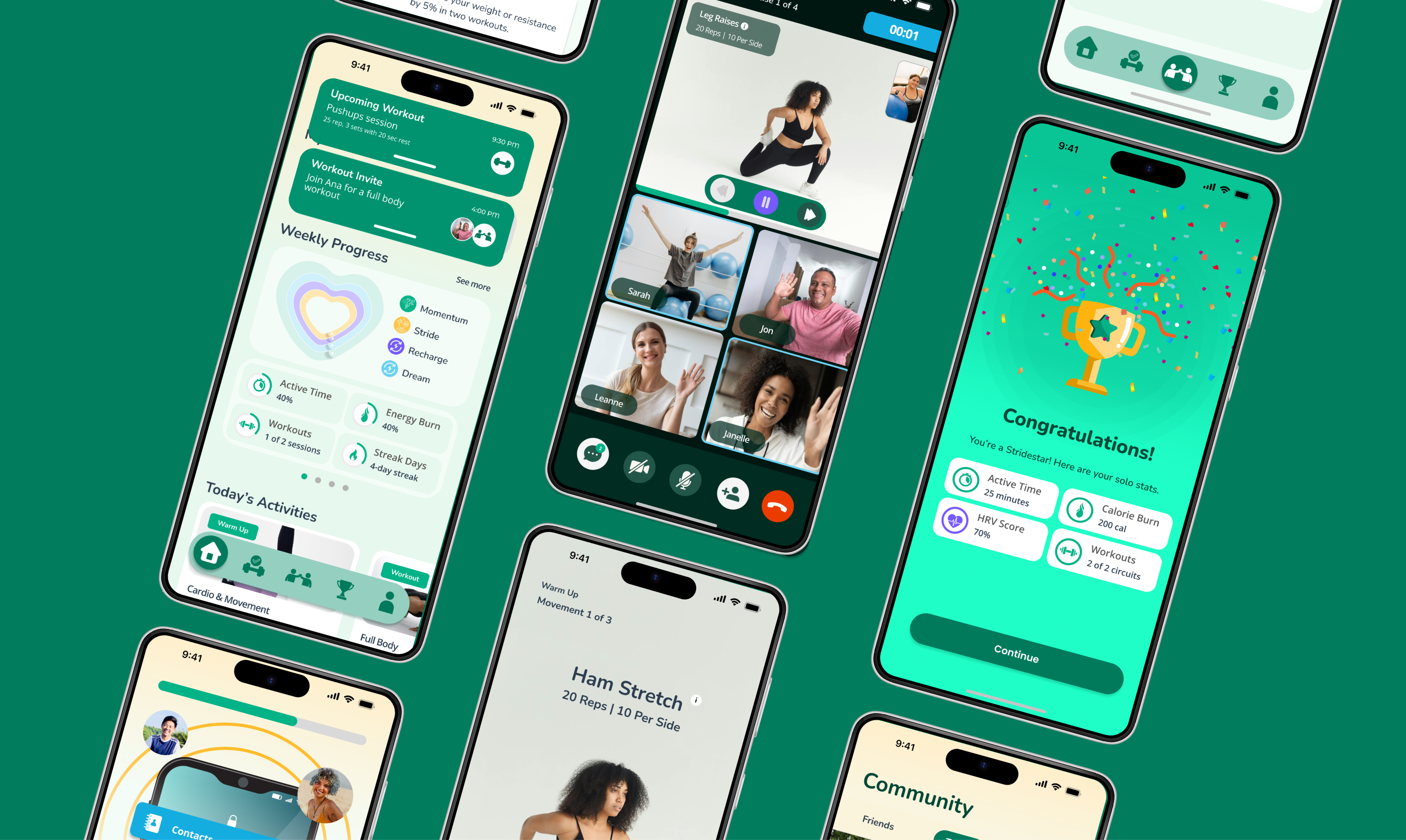
StrideWell is a fitness experience designed to support consistency without pressure. The goal was to make it easy to return after missed days while using community and group goals to encourage motivation. As the sole designer, I created a fitness experience framed as supportive, shared, and sustainable over time.
Design Lead, UX Researcher, UI Designer, Brand Creator
June-July 2025 (5 weeks)
Figma, Adobe Illustrator
Stridewell began as a capstone project within a UX design program, based on a scenario describing a mature fitness app struggling with retention. The original brief focused on adding messaging features to increase engagement. However, as I moved into research, it became clear that messaging alone would not solve the problem. Users weren’t disengaging due to a lack of communication tools—they were disengaging because existing fitness systems failed to support them when motivation naturally declined.
I designed Stridewell end-to-end as a solo UX designer, leading user research, product strategy, interaction design, visual design, and iterative usability testing. The work demonstrates my approach to UX as a behavioral system: designing for emotional context, habit formation, and long-term engagement rather than idealized usage or surface-level metrics.
This updated version of Stridewell reframes fitness as a shared experience rather than a solo obligation. By embedding messaging, shared workouts, and flexible challenges directly into the core experience, the app replaces short-lived motivation with social momentum. Users can choose how they engage—individually, collaboratively, or through friendly competition—making it easier to return after missed days and build sustainable habits without performance pressure.

To understand why users disengage, I conducted brief guerrilla qualitative interviews with people at local fitness centers, uncovering real needs and pain points. Among those who stopped by my booth, I spoke with those who regularly download fitness apps but struggle to maintain consistency. These conversations focused less on workouts and more on emotional experience—how missed days feel, how social features create pressure or hesitation, and what actually helps people return after disruption.




A consistent pattern emerged. Motivation was front-loaded and fragile. Users often started strong, but once routines were interrupted by work, illness, fatigue, or life events, they felt behind. Streak loss and performance metrics turned small lapses into perceived failure. Social features—when unclear or competitive—added emotional risk rather than support. Instead of restarting, many users disengaged entirely.
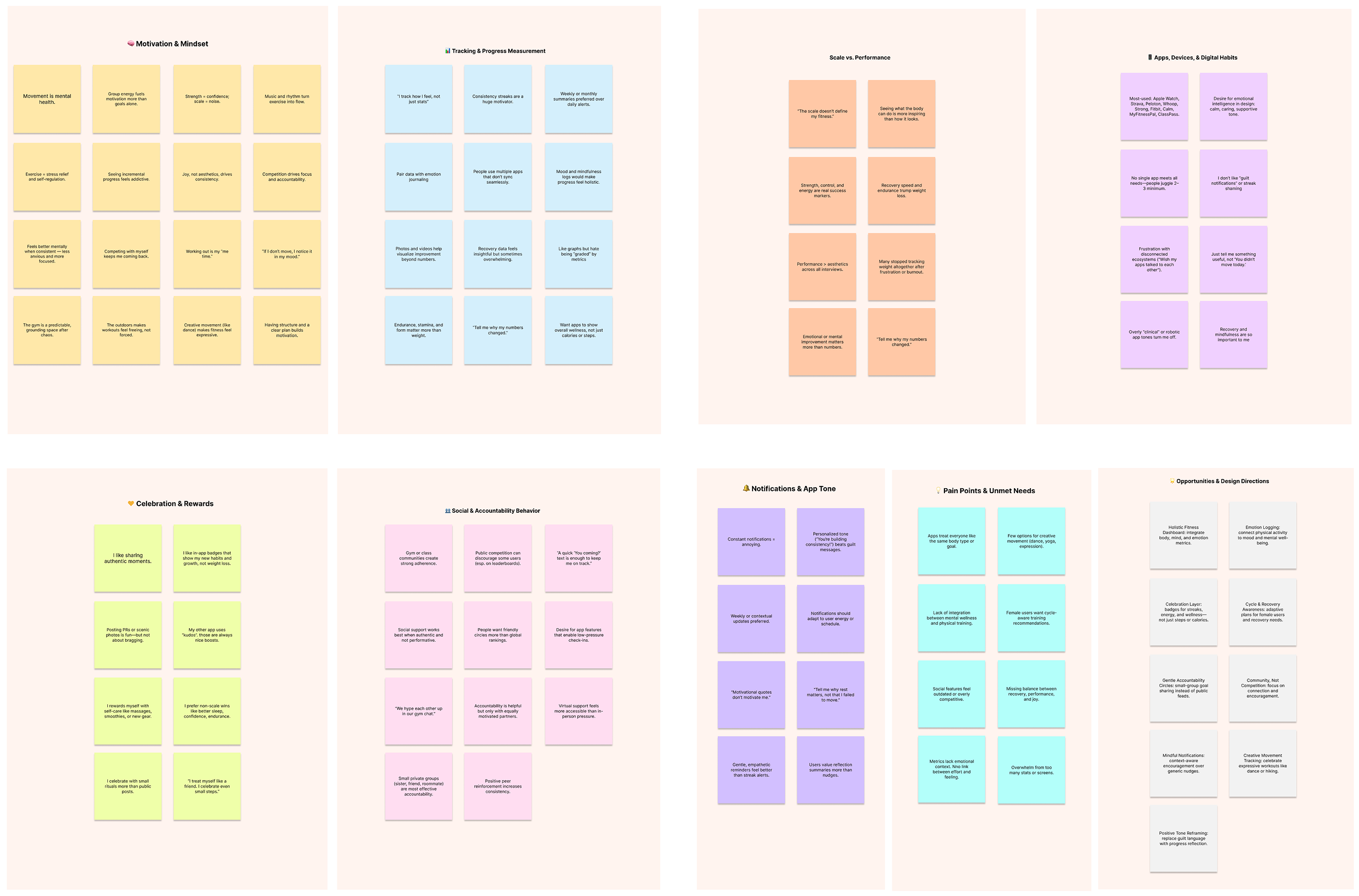
This research challenged a core assumption of the brief. The problem was not “how do we motivate users more?” but rather “how do we design a system that supports consistency when motivation fluctuates?” Engagement, I learned, is less about frequency or intensity and more about return behavior—whether a product makes it emotionally easy to come back after a break.
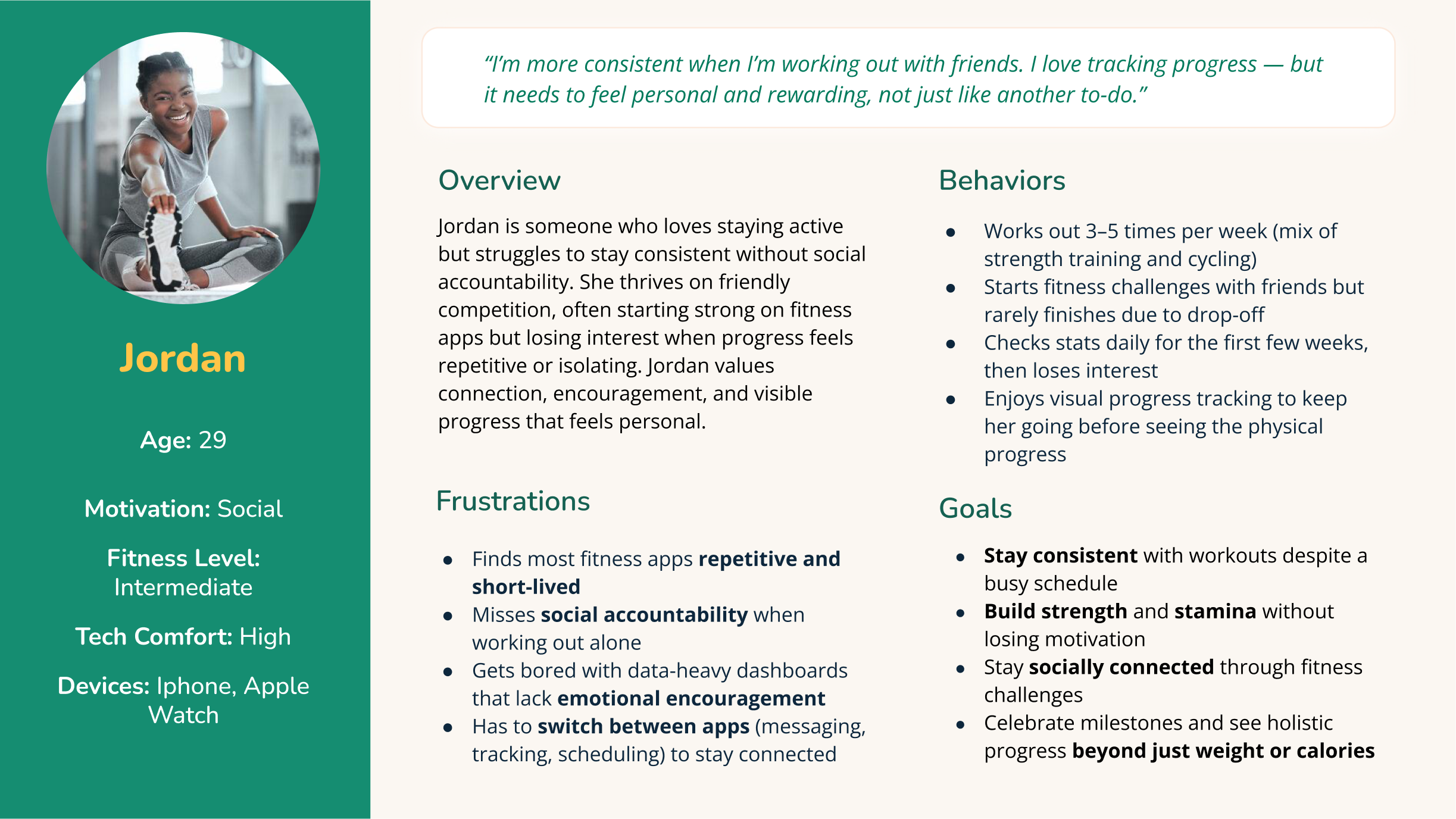
I created the persona Jordan to represent the most common behavioral pattern observed across research: someone who values fitness and social connection but struggles to stay consistent when motivation becomes isolated or routine-driven. Jordan is not an edge case or aspirational athlete—she reflects users who start strong, care about progress, but disengage when apps feel impersonal, repetitive, or emotionally demanding.
Throughout the design process, Jordan served as a decision filter. I consistently asked whether a feature reduced pressure or added it, whether it acknowledged imperfect effort, and whether social participation felt clear and optional. This helped me prioritize integrated social touchpoints, flexible challenges, encouragement over comparison, and holistic progress signals—resisting the pull to design for ideal behavior rather than real life.
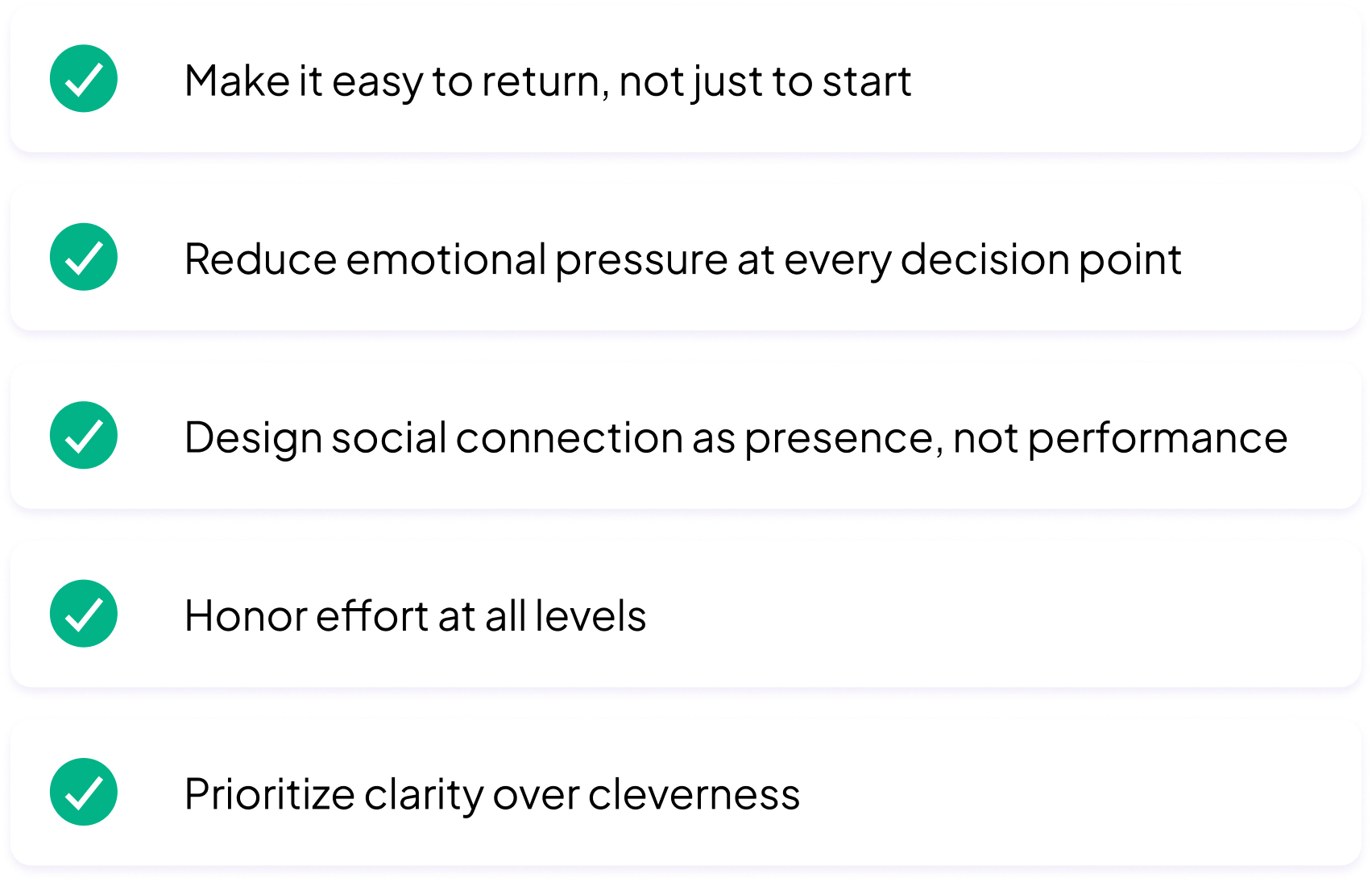
After synthesizing research insights, I established a small set of experience principles that functioned as practical constraints rather than aspirational ideals. These principles guided every design decision and trade-off throughout the project:
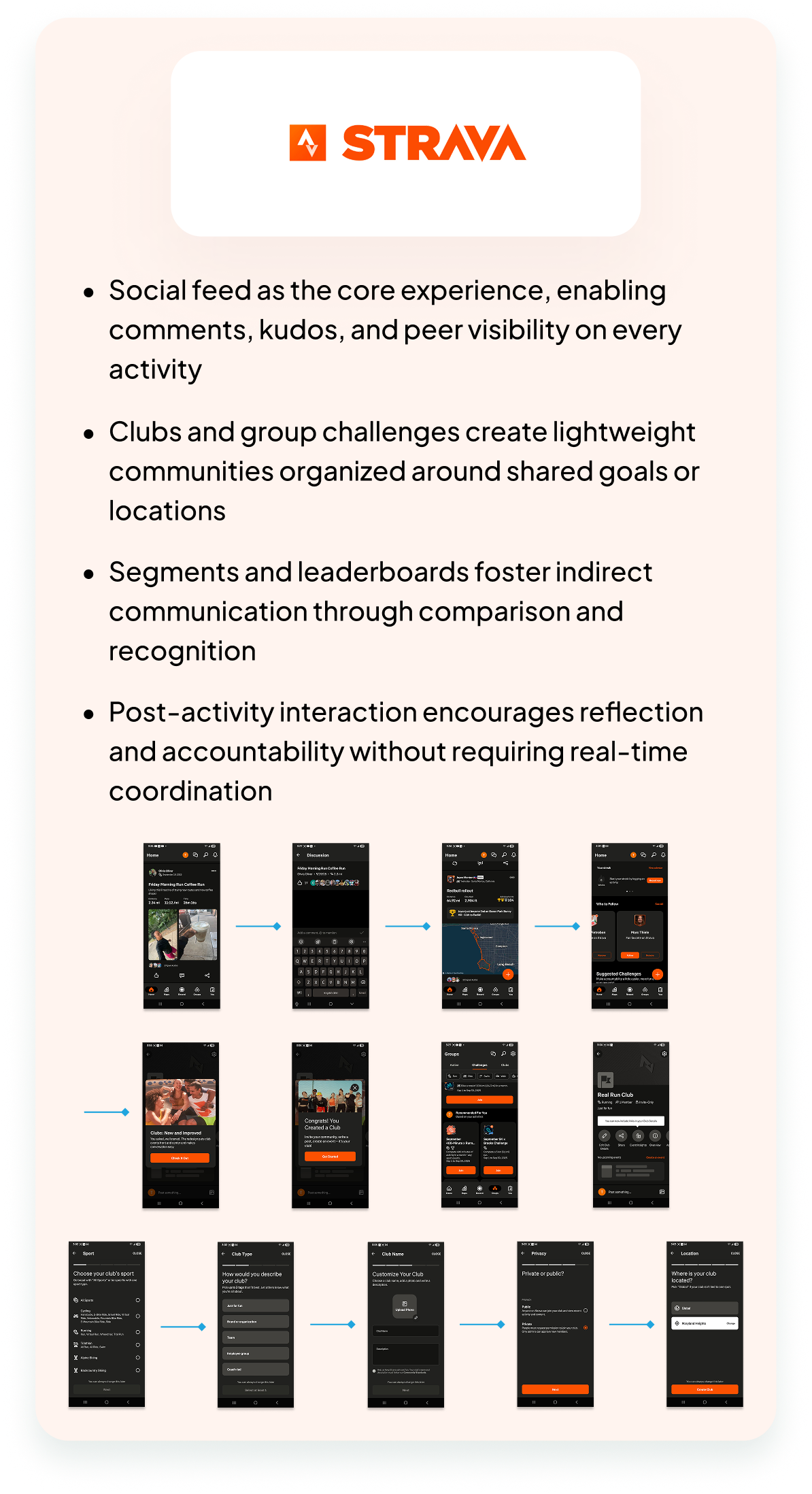
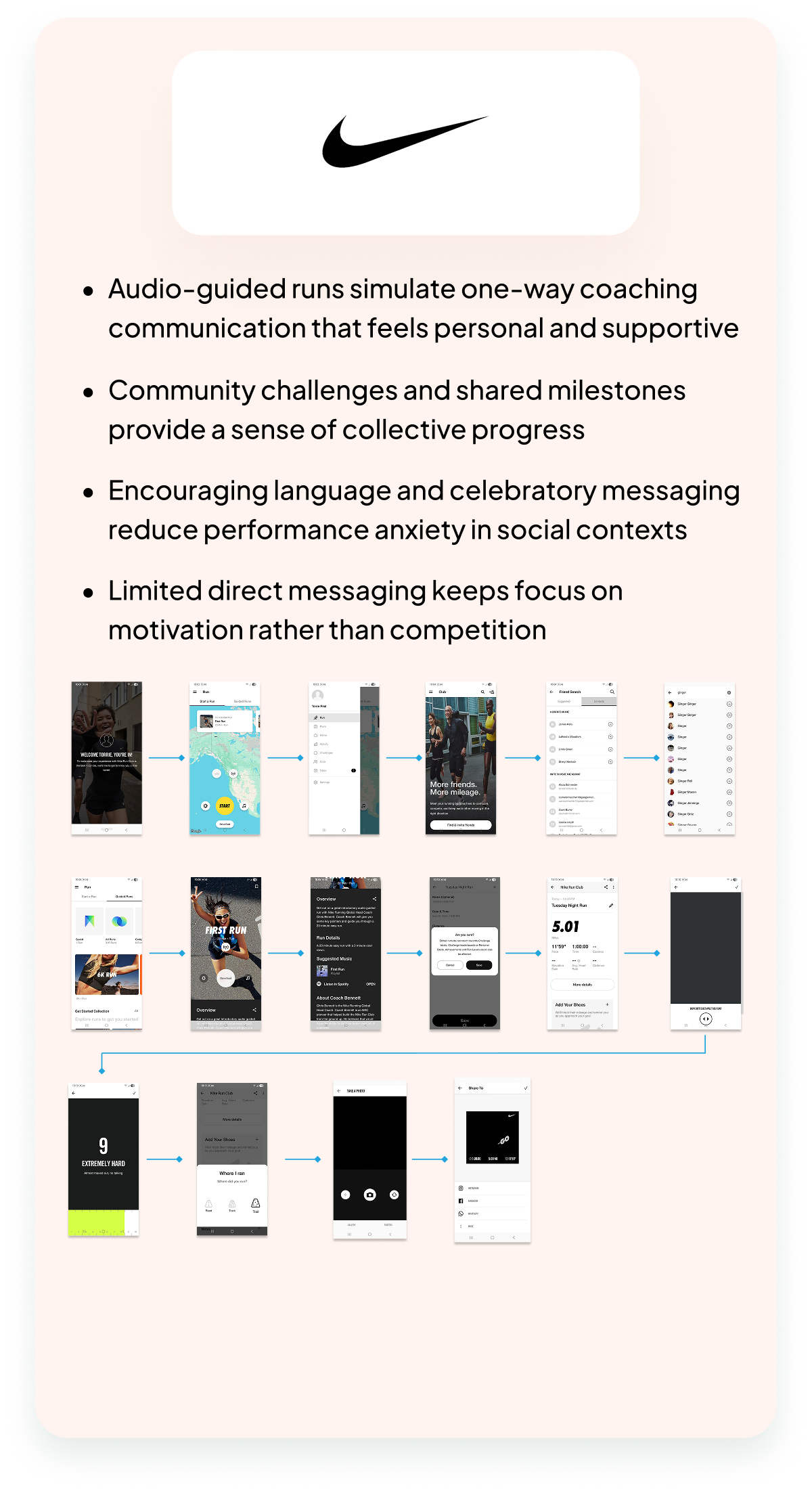
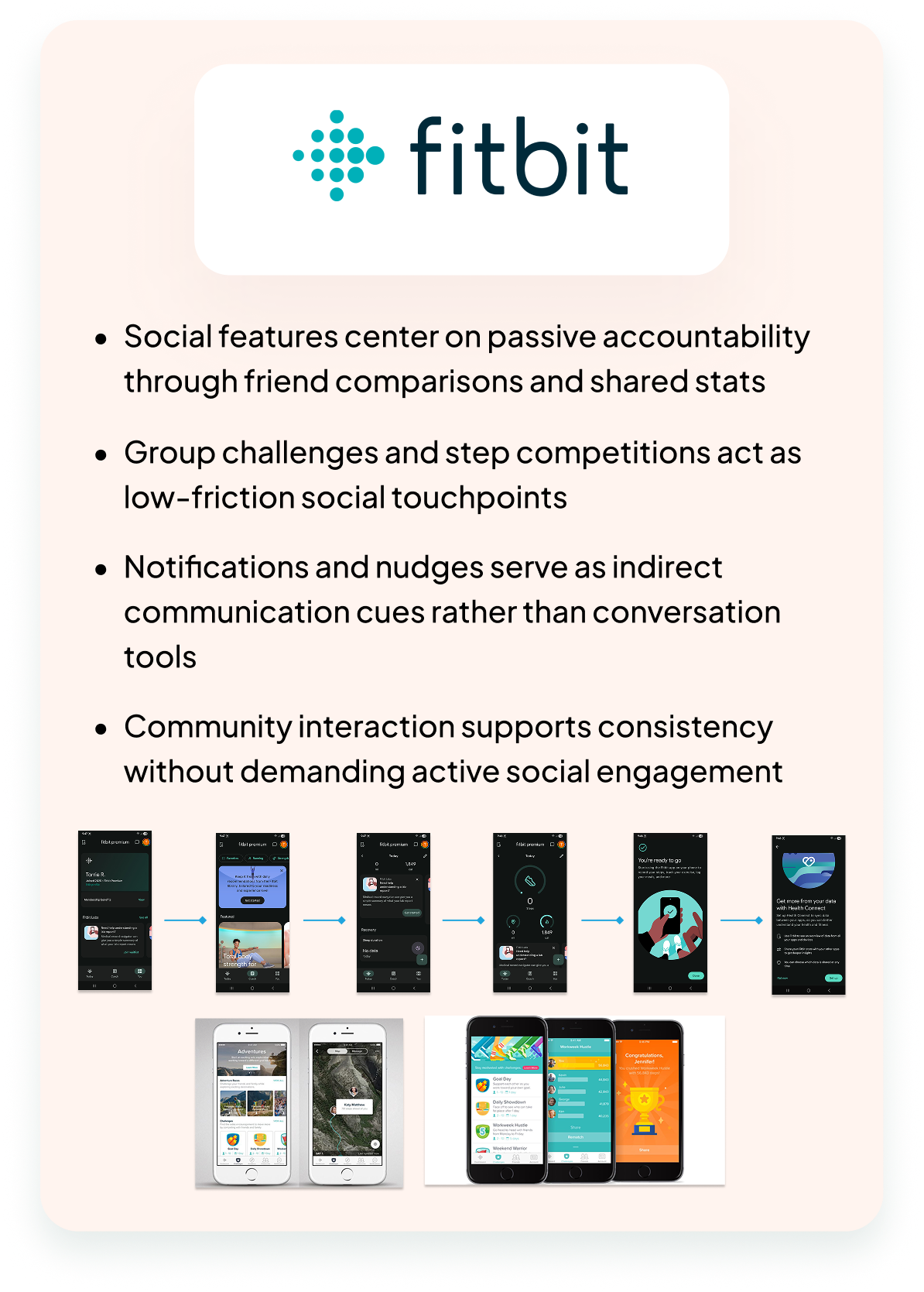
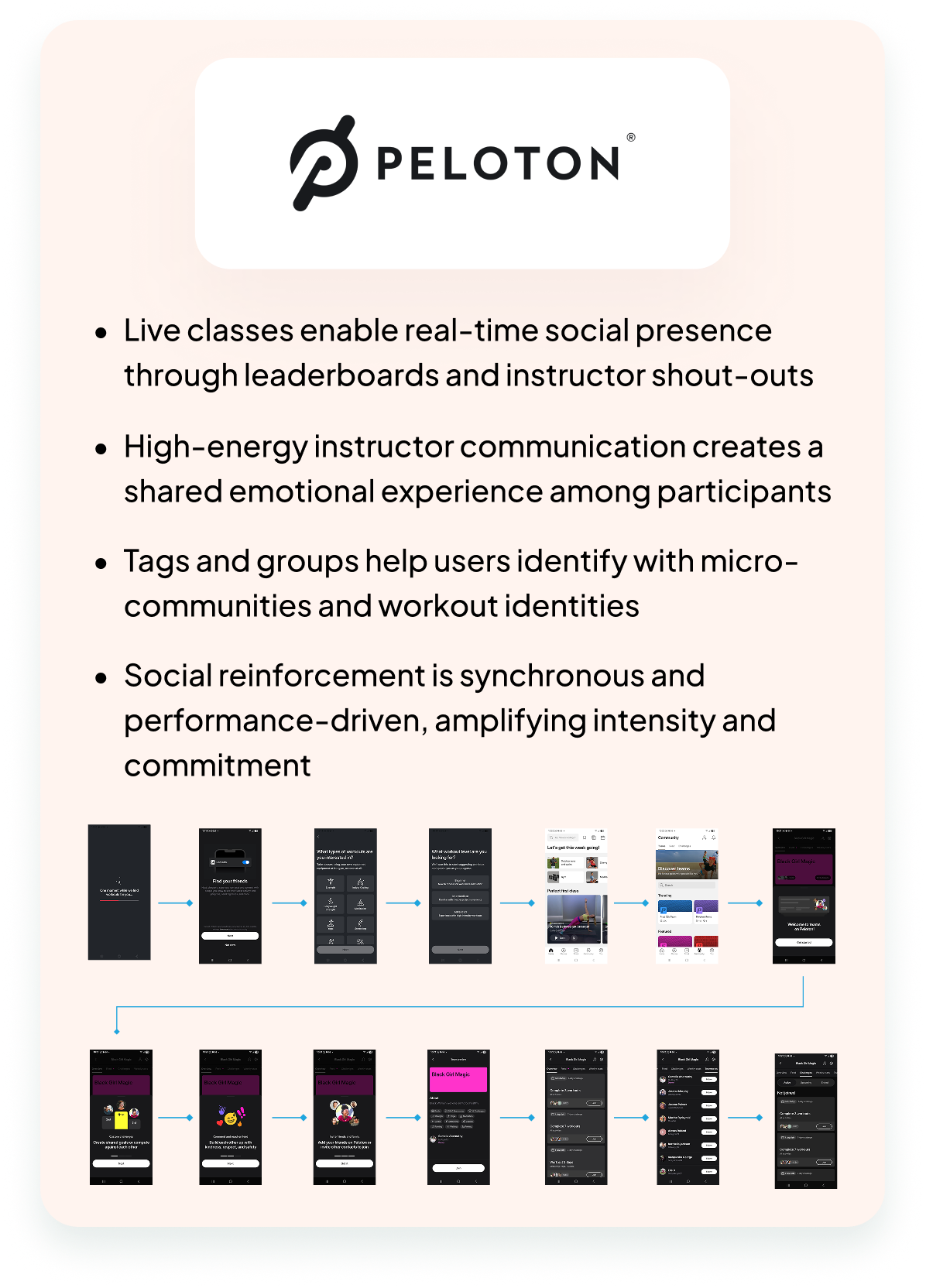
I analyzed apps including Strava, Nike Run Club, Fitbit, and Peloton across key criteria such as community features, motivation systems, coaching support, and message integration.
I defined Stridewell’s core loop as a simple, forgiving cycle:
Open the app → assess energy and intent → choose how to participate (solo or shared) → complete movement → receive acknowledgment → feel supported enough to return.
This loop reflects the reality that users often open fitness apps in low-to-moderate motivation states, checking whether participation feels doable. The goal was not to push users toward ambition, but to reinforce the belief that showing up in any form still counts.
I made a deliberate distinction between private and social moments. Private interaction was prioritized during vulnerable decision-making points—assessing energy, deciding whether to start, or recovering after missed days—where autonomy and low pressure were essential. Social elements were introduced after commitment, reinforcing momentum rather than becoming a barrier to action. This sequencing allowed social presence to support behavior instead of amplifying hesitation.
The loop was designed to reinforce three behaviors:
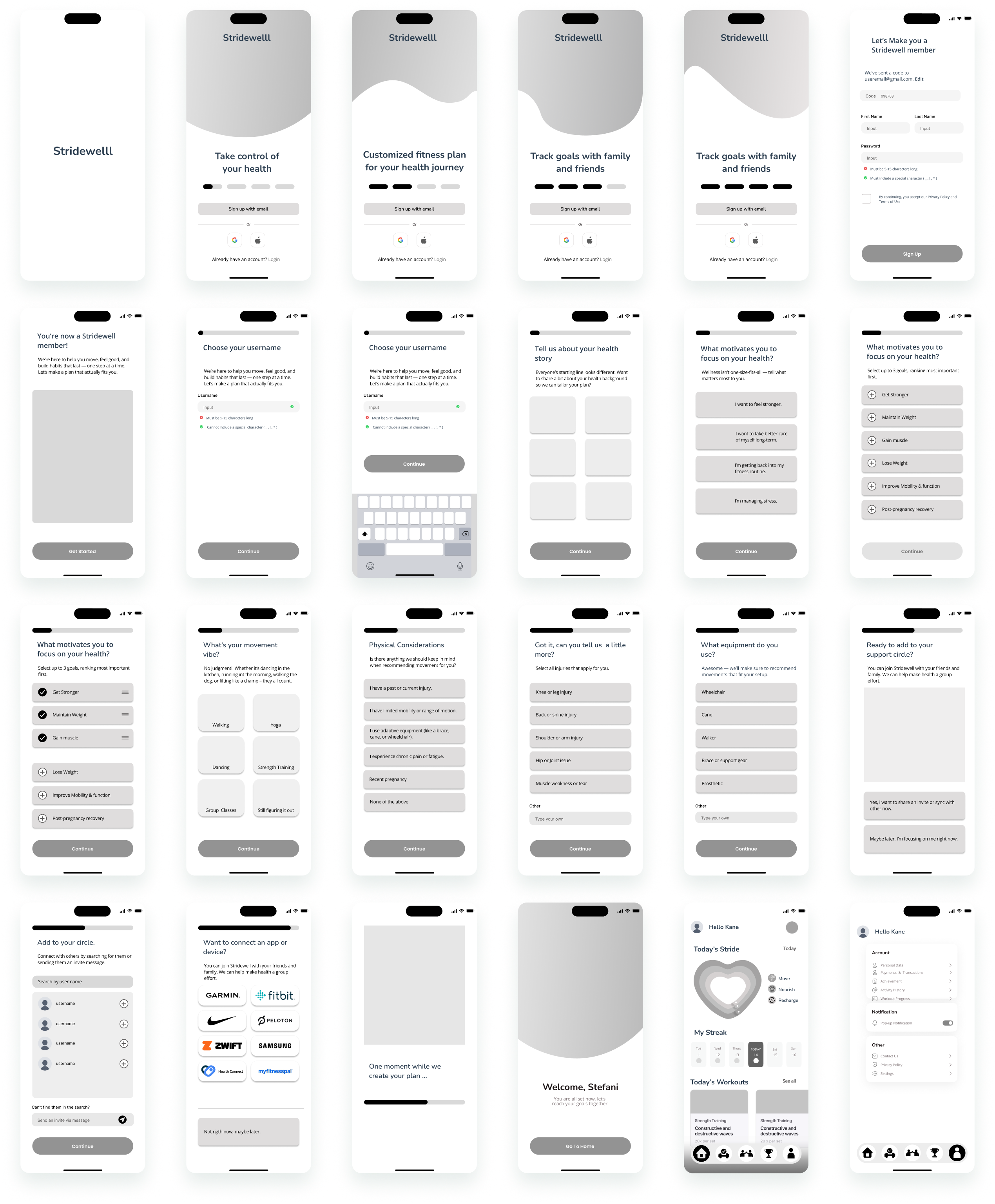
The color palette was intentionally selected to balance warmth, clarity, and emotional reassurance while supporting quick decision-making and sustained engagement.
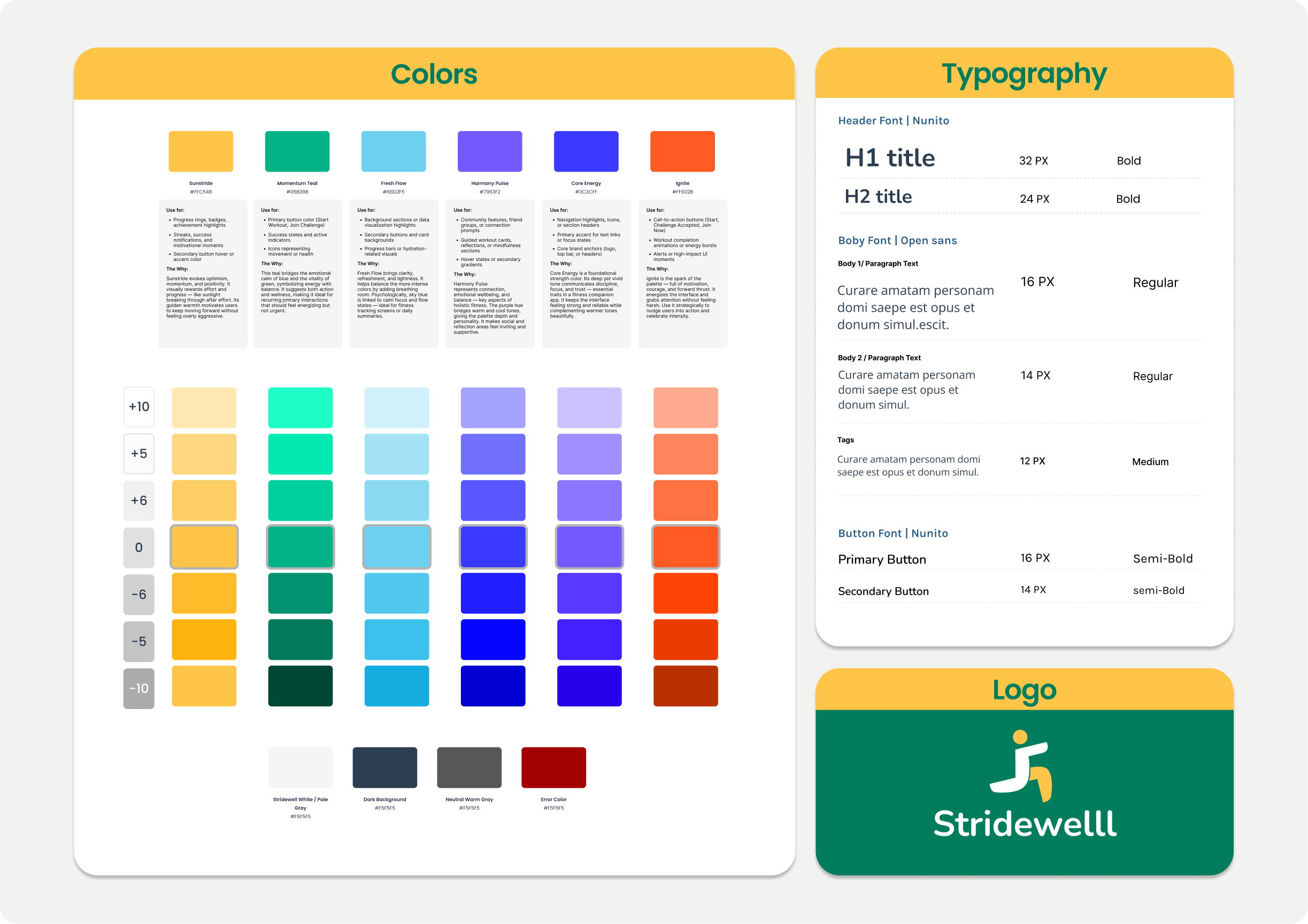
Together, these colors create a system that feels supportive, legible, and emotionally balanced—designed to guide users calmly while still encouraging momentum and progress.
Round 1 usability testing revealed that users were interested in the concept but hesitated at moments where social expectations were unclear.
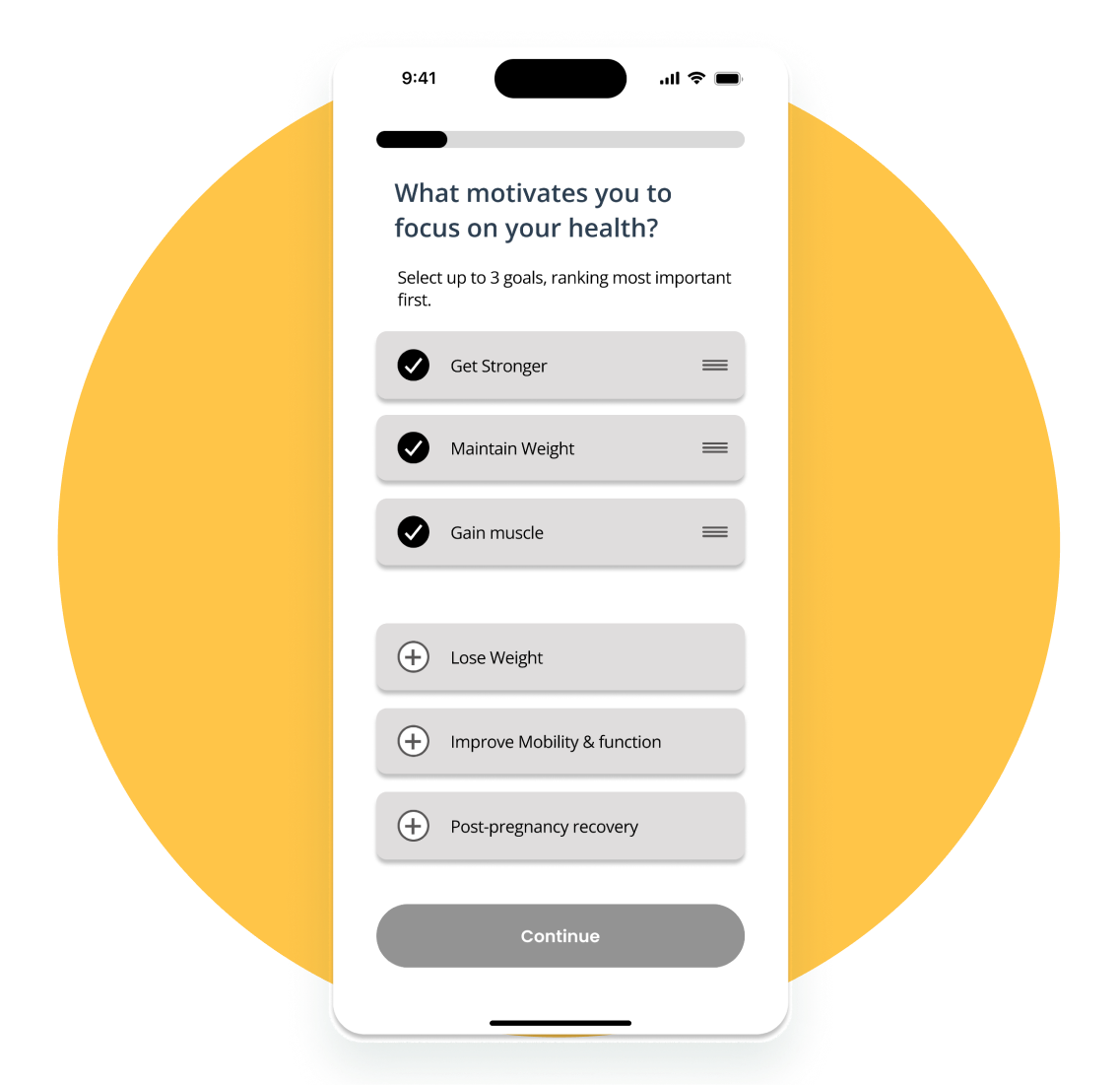
People appreciated the friendly onboarding but wanted clearer explanations for why information was requested and how answers shaped recommendations. Some also felt the flow was too long and asked for quicker setup or a save-and-finish-later option.
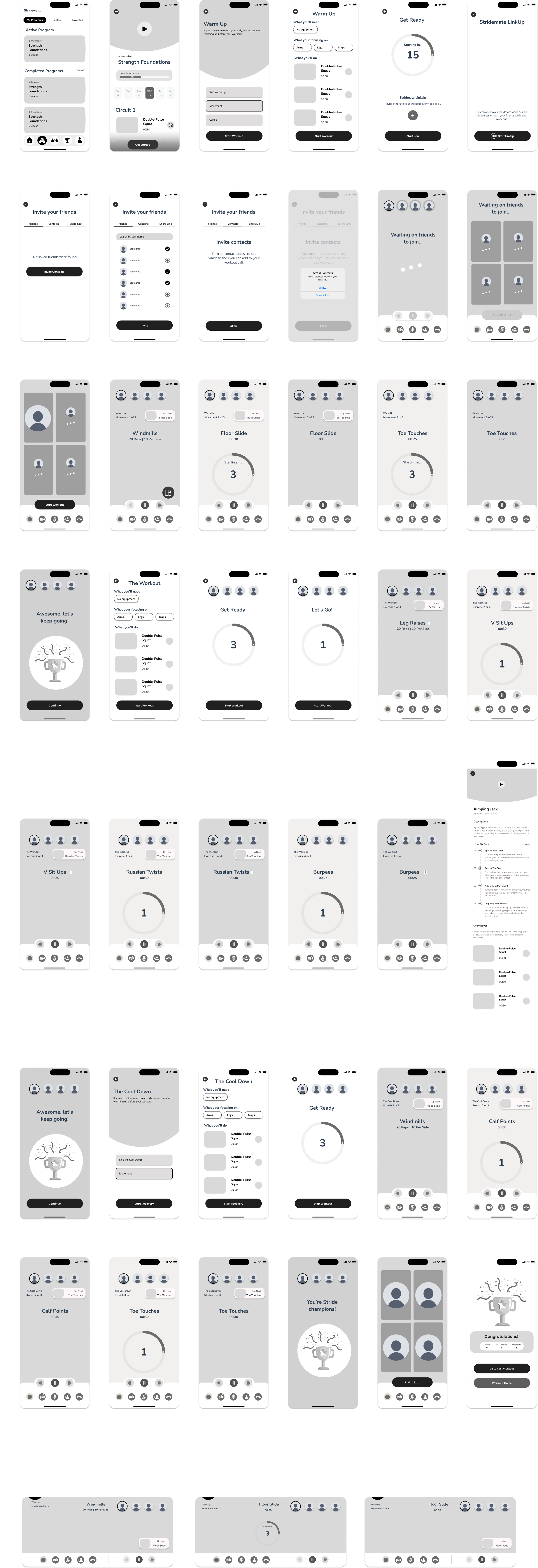
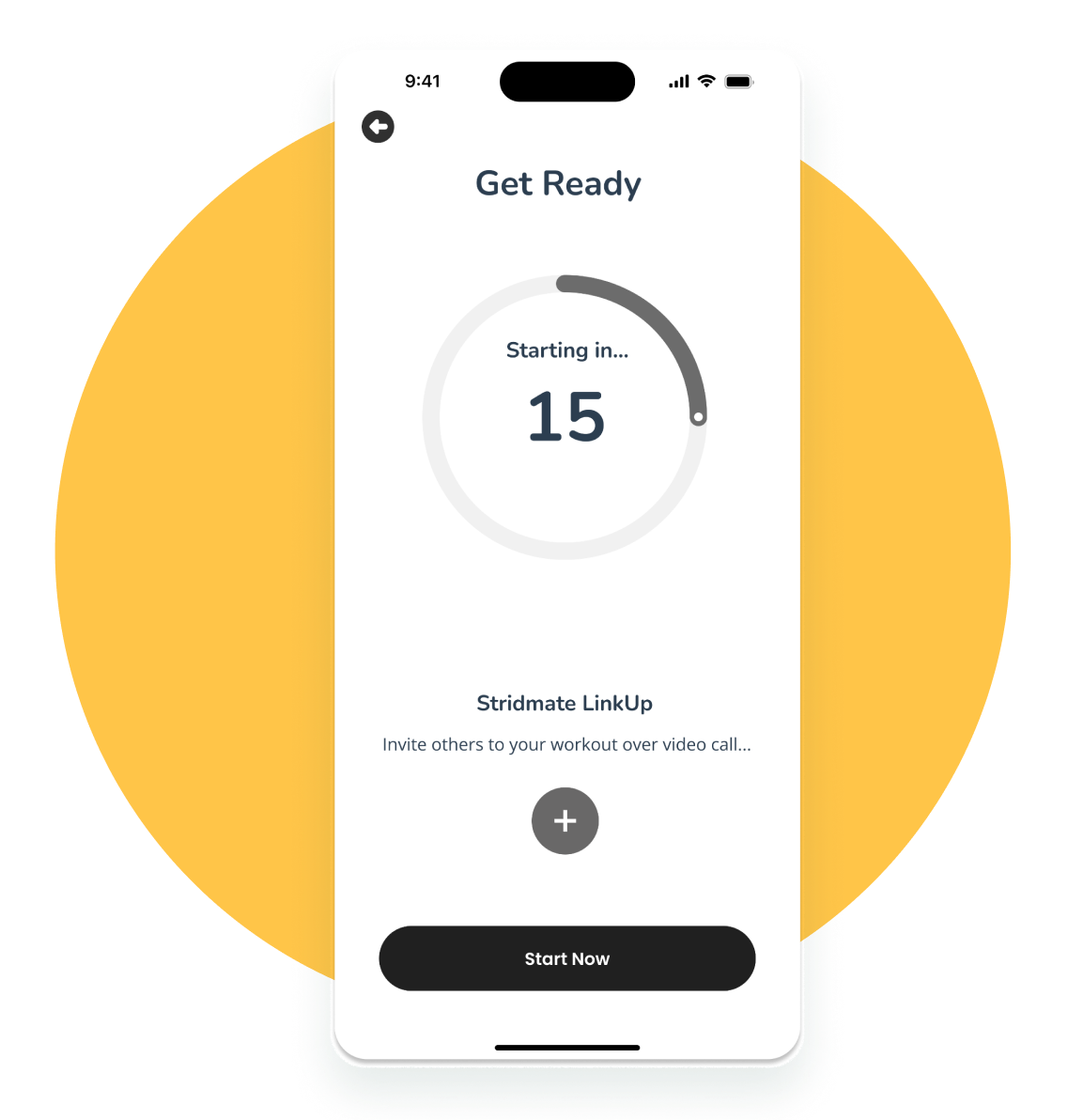
Everyone could find the strength workouts, but several people wanted a short description or preview before the workout automatically started. When users saw the “Create Virtual Workout” button, they weren’t sure what that meant—was it a live class, a synced start time, or something else?
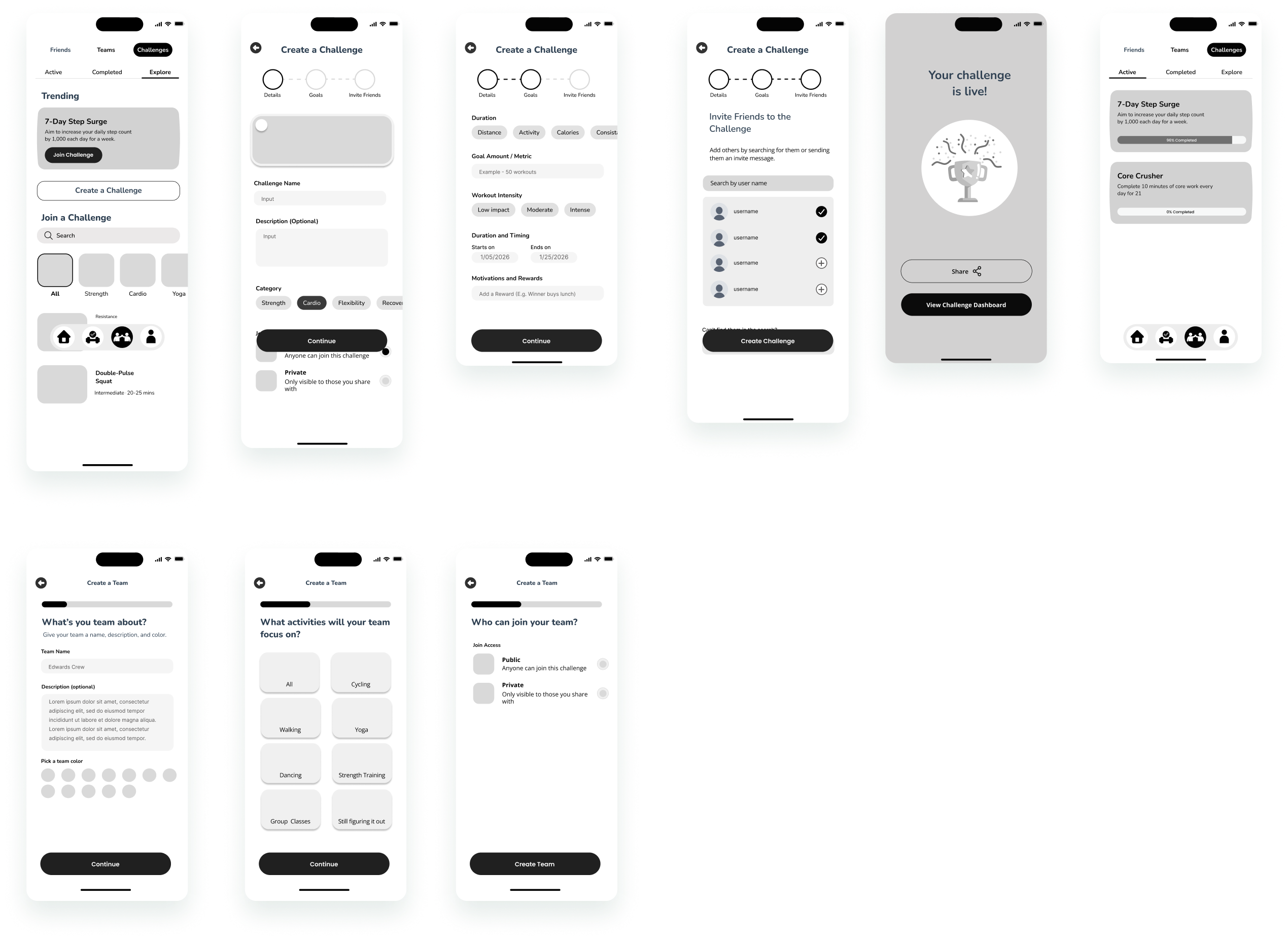
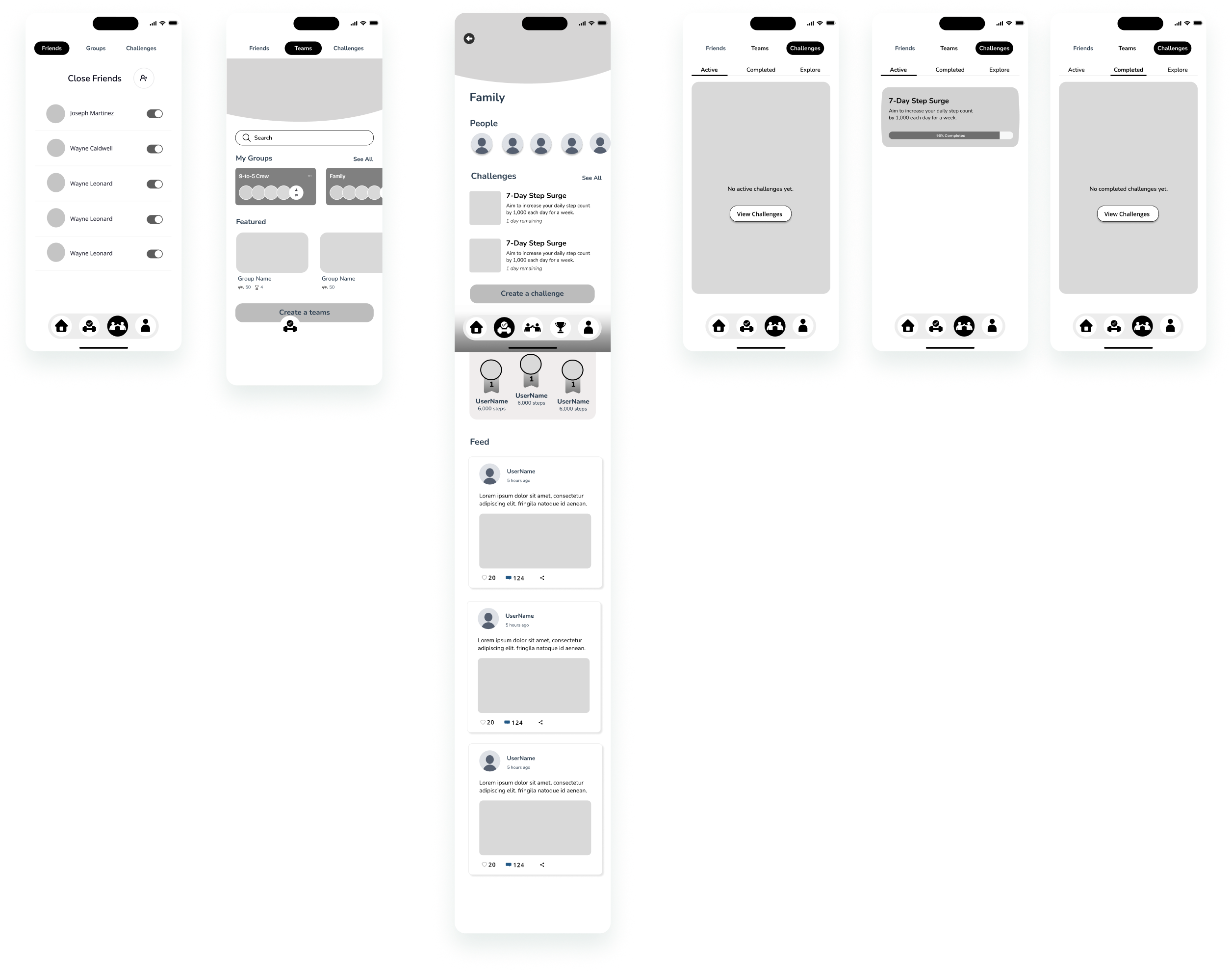
Creating a group was one of the most exciting parts of testing. Users said it made fitness feel more social and fun, especially for families. Still, they wanted to make the groups feel more theirs—adding a group photo, an emoji, or team colors. Parents also wanted simpler profiles for kids, so families could stay involved without needing full accounts for everyone.
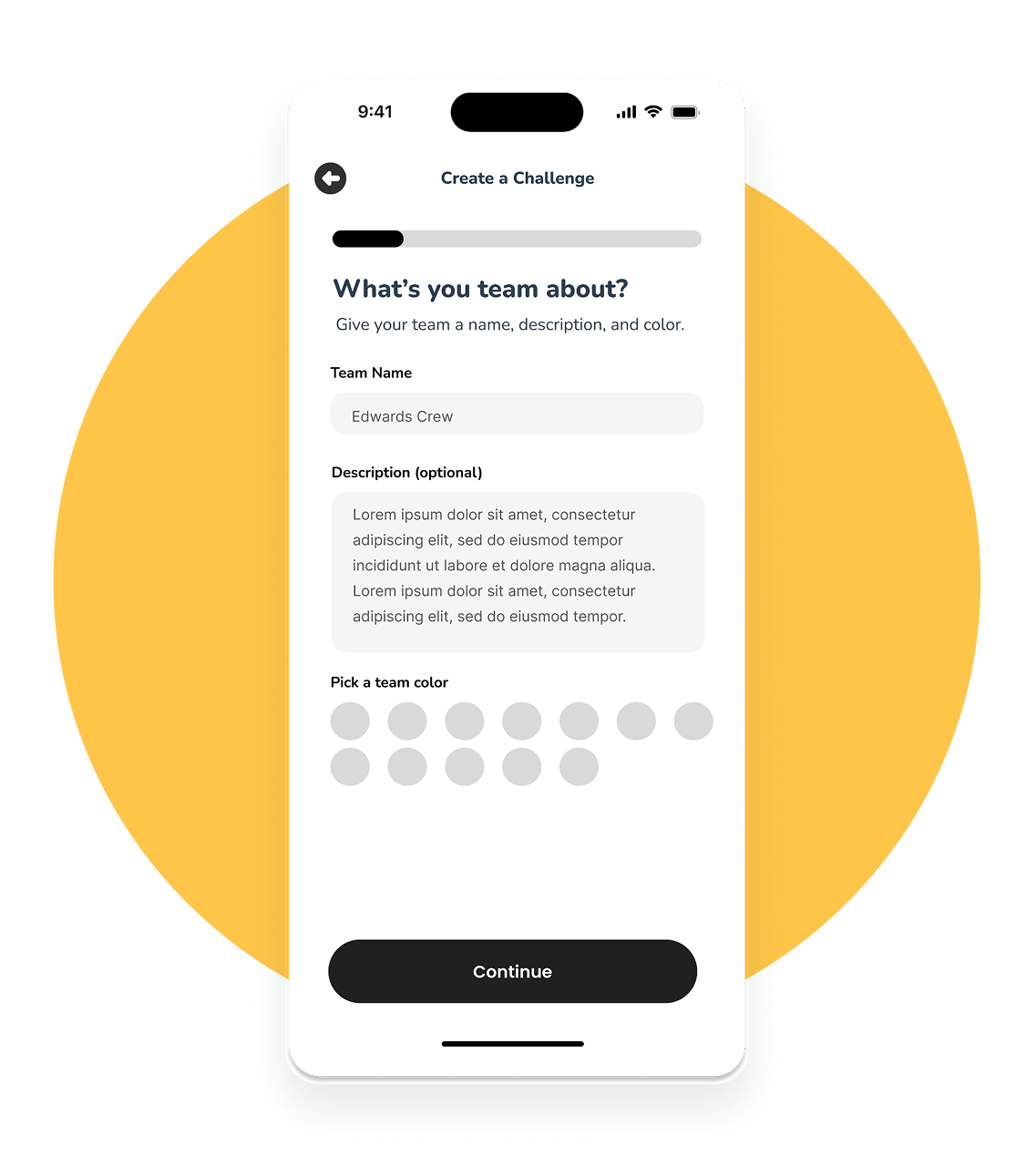
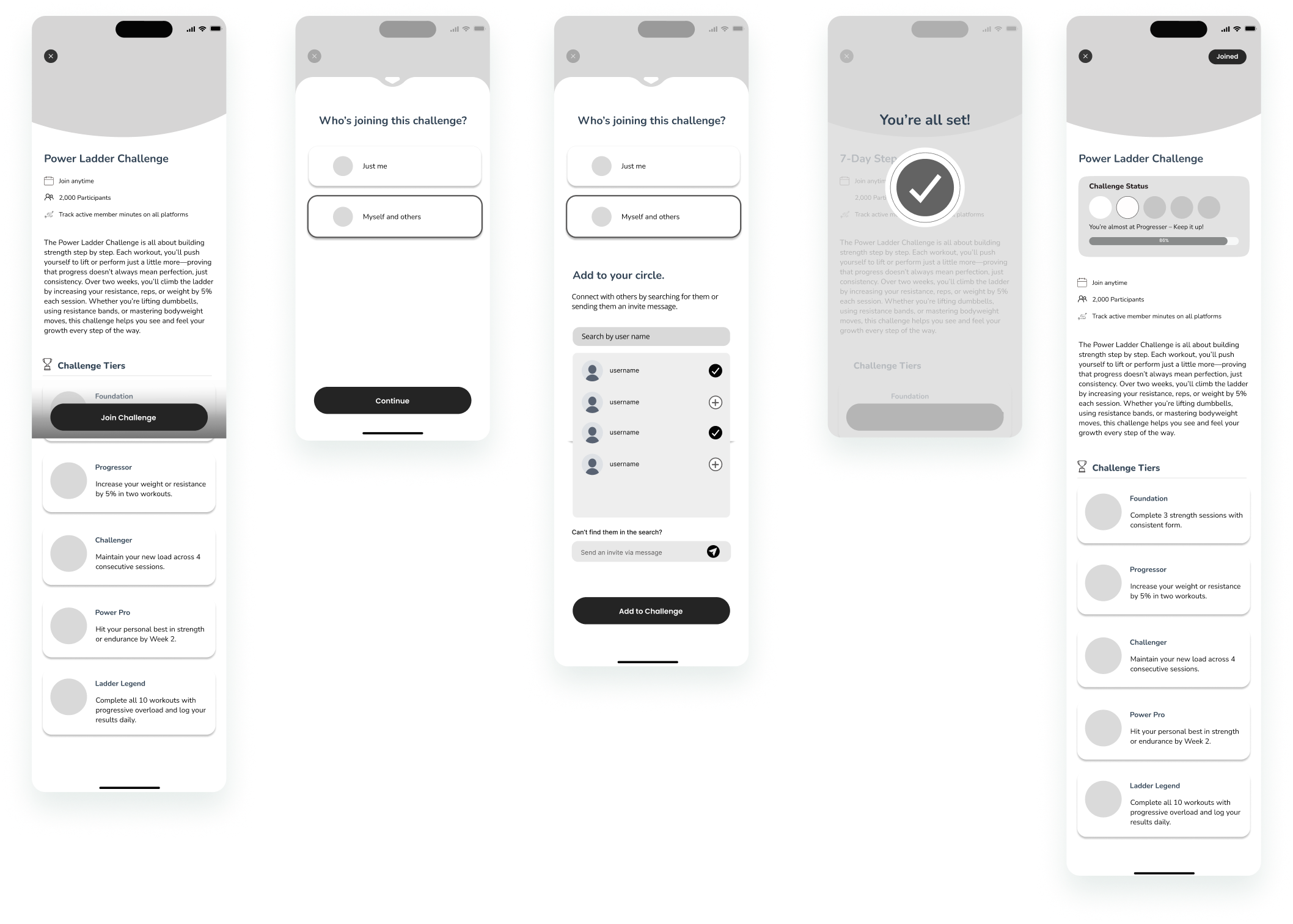
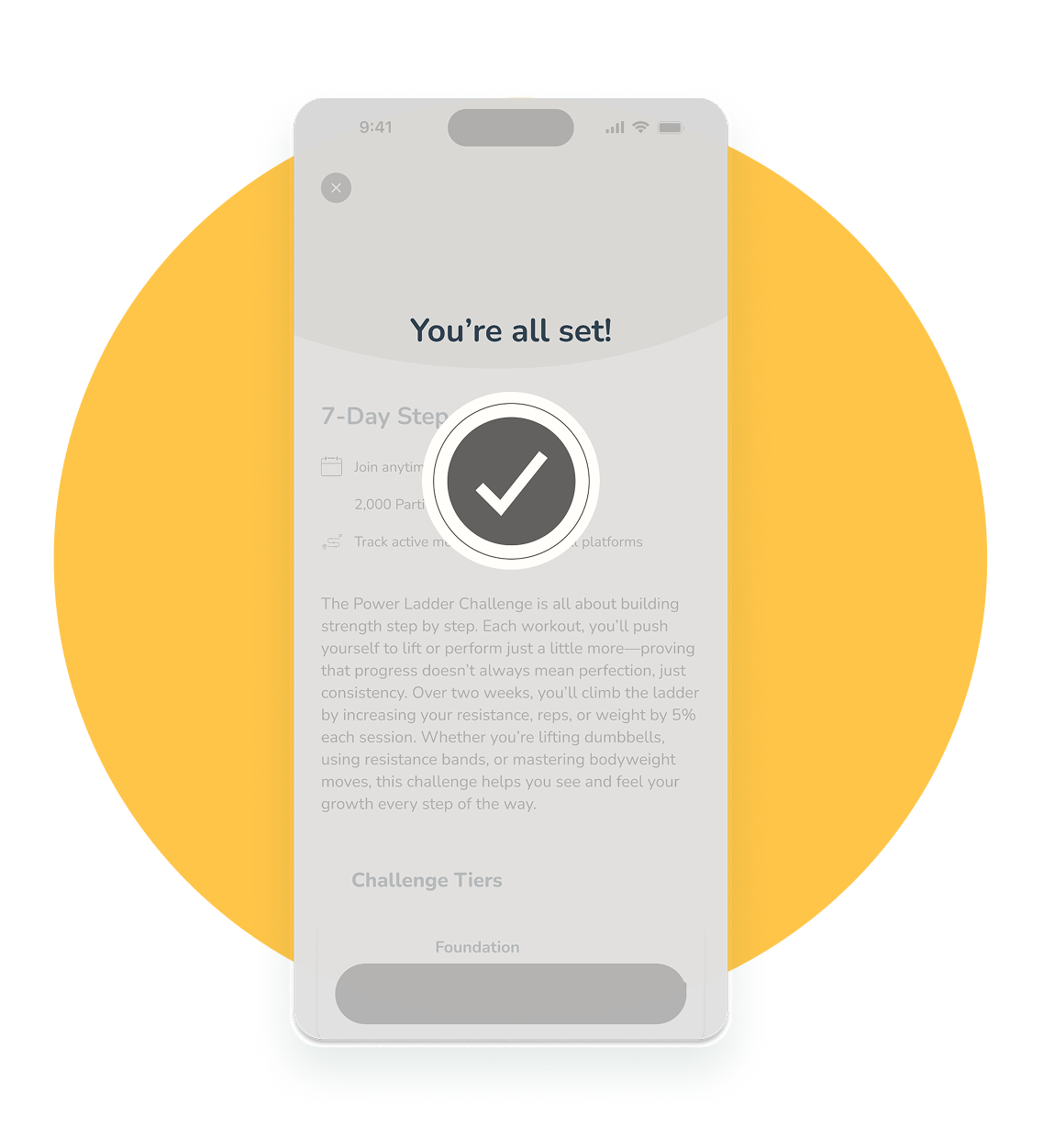
Everyone loved the challenge feature. They said it was “fun,” “motivating,” and made them want to bring others along. Still, several users got tripped up trying to connect a challenge to a group or wished there were ready-made options. When a challenge was created, users expected a little celebration or confirmation but were taken straight back to the dashboard instead.
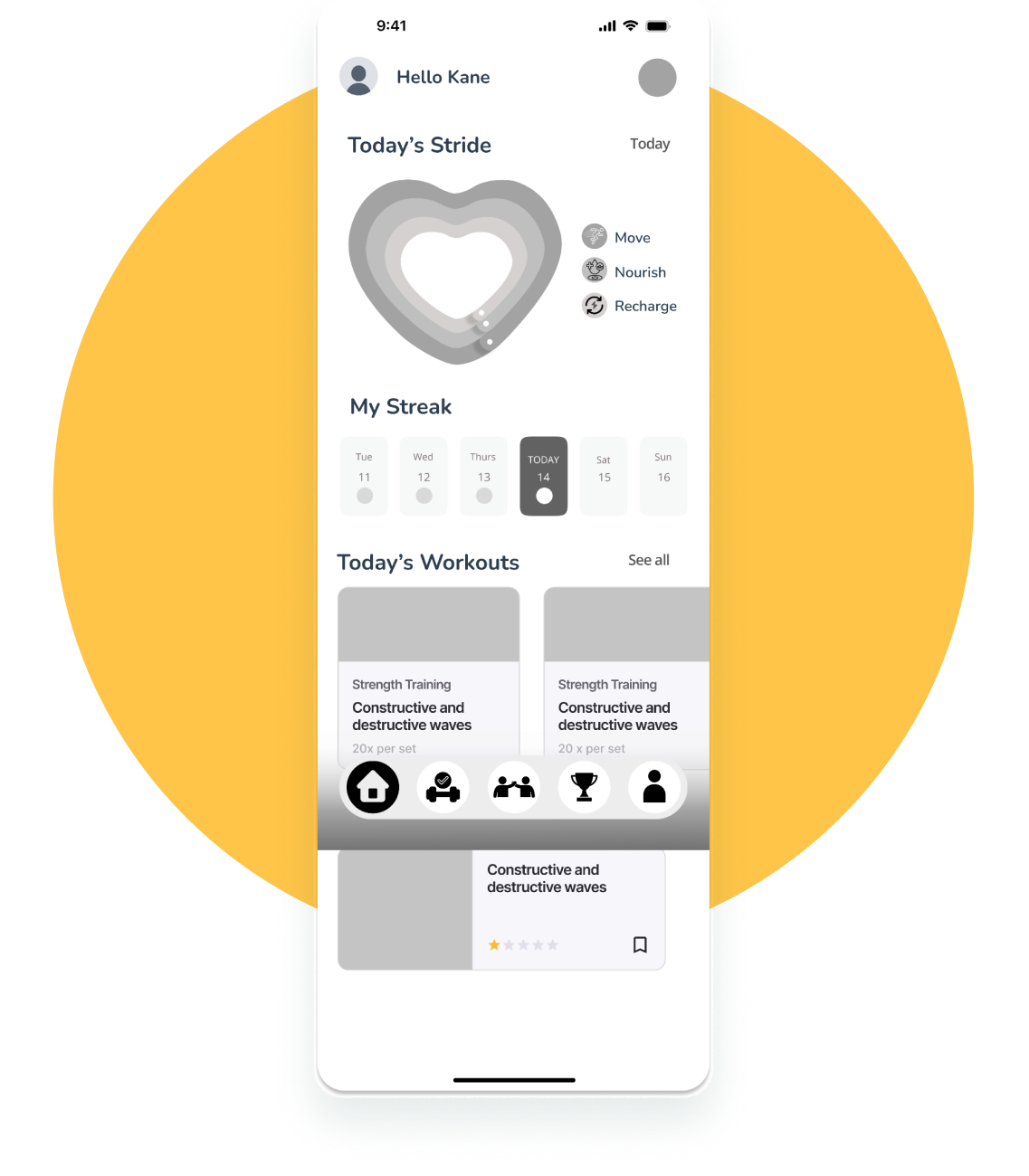
A few users clicked the wrong buttons (like “Join” instead of “Invite”) because the icons looked similar. The “Nourish” ring on the home screen was also confusing—users didn’t know what it represented or how to engage with it.
Round 1 usability Round 2 usability testing showed clear improvement over earlier designs. Participants moved through key flows with less hesitation and asked fewer clarification questions. Users identified participation modes more quickly and no longer expressed concern about what others would see or what would happen if they didn’t finish.
Reductions in confusion were most notable at entry points to shared workouts and challenges, where expectation previews eliminated second-guessing; during mode selection, which users described as intuitive rather than intimidating; and in post-activity feedback, which no longer triggered anxiety around performance or comparison.
Emotionally, users described the final experience as supportive, calm, and reassuring. Language was frequently characterized as “kind,” “human,” and “non-judgmental.” Participants expressed relief at the reversibility of actions and the absence of penalty. Overall, emotional responses shifted from caution and self-consciousness to confidence and ease—directly aligning with the project’s core goals.
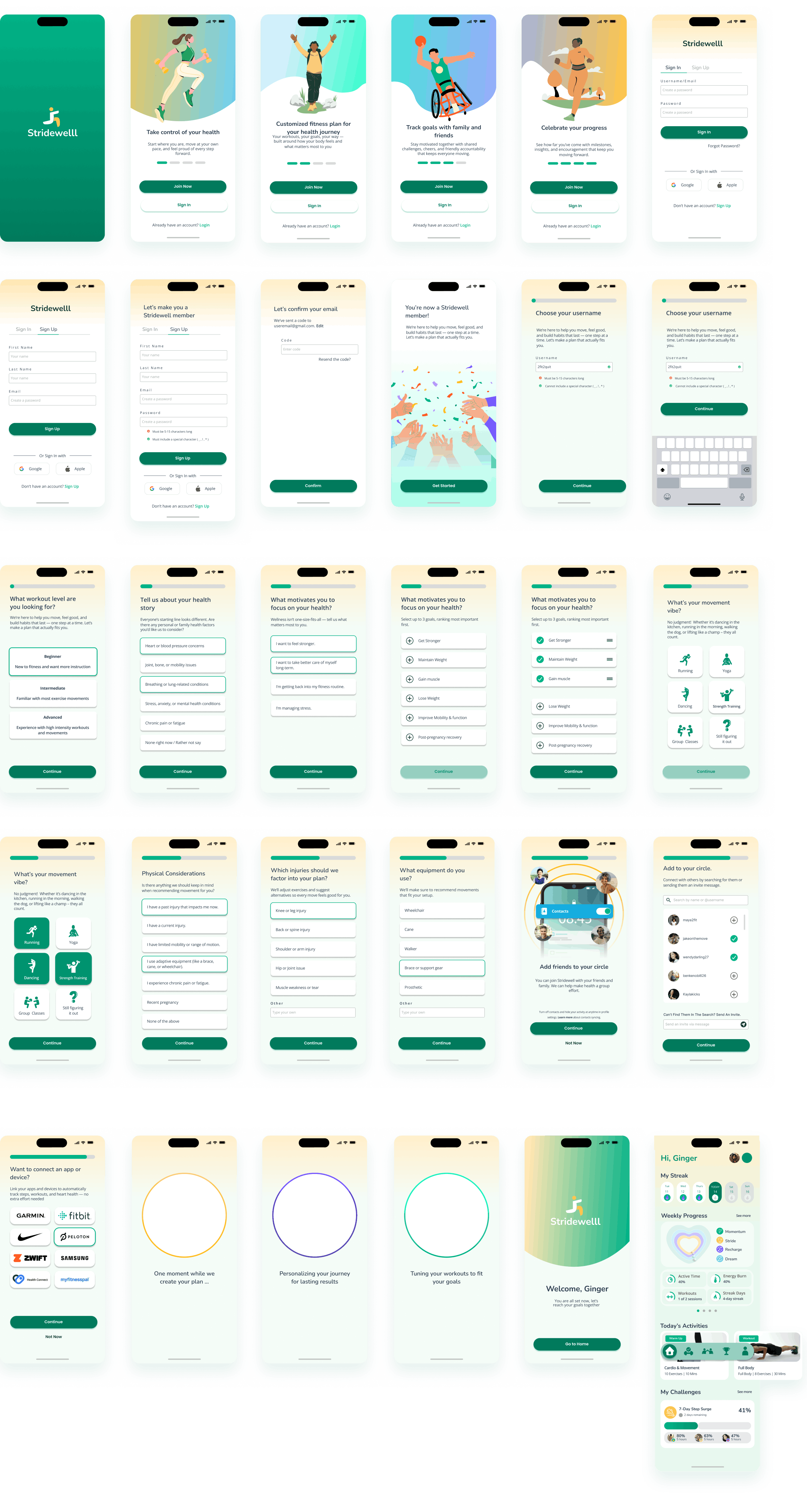
The final Stridewell experience is designed as a calm, supportive fitness companion that meets users where they are. Rather than demanding performance or perfection, the app helps users quickly assess what feels doable today and decide how they want to participate—alone or with others. The experience is intentionally simple: choose an effort level, select a participation mode, move, and feel acknowledged for showing up.
Unlike traditional fitness apps that overwhelm users with data, rigid plans, or streak-based pressure, Stridewell prioritizes reassurance and momentum. It feels less like a tracker and more like a system designed to help users keep going—even during low-energy days, disrupted routines, or periods of reduced motivation.
Stridewell is particularly effective at addressing early disengagement caused by guilt, pressure, and isolation—the point where most fitness apps lose users. The design focuses on making re-entry easy after missed days by removing emotional penalties, clarifying social expectations, and acknowledging effort at every level.
Rather than only helping users start workouts, Stridewell helps them come back without feeling like they failed. This emphasis on recovery and continuity reframes fitness as an ongoing relationship rather than a test of discipline.
What fundamentally differentiates Stridewell is its assumption that motivation fluctuates. Social features feel human rather than performative, progress feels personal rather than comparative, and success is defined by continuity—not streaks, intensity, or metrics.
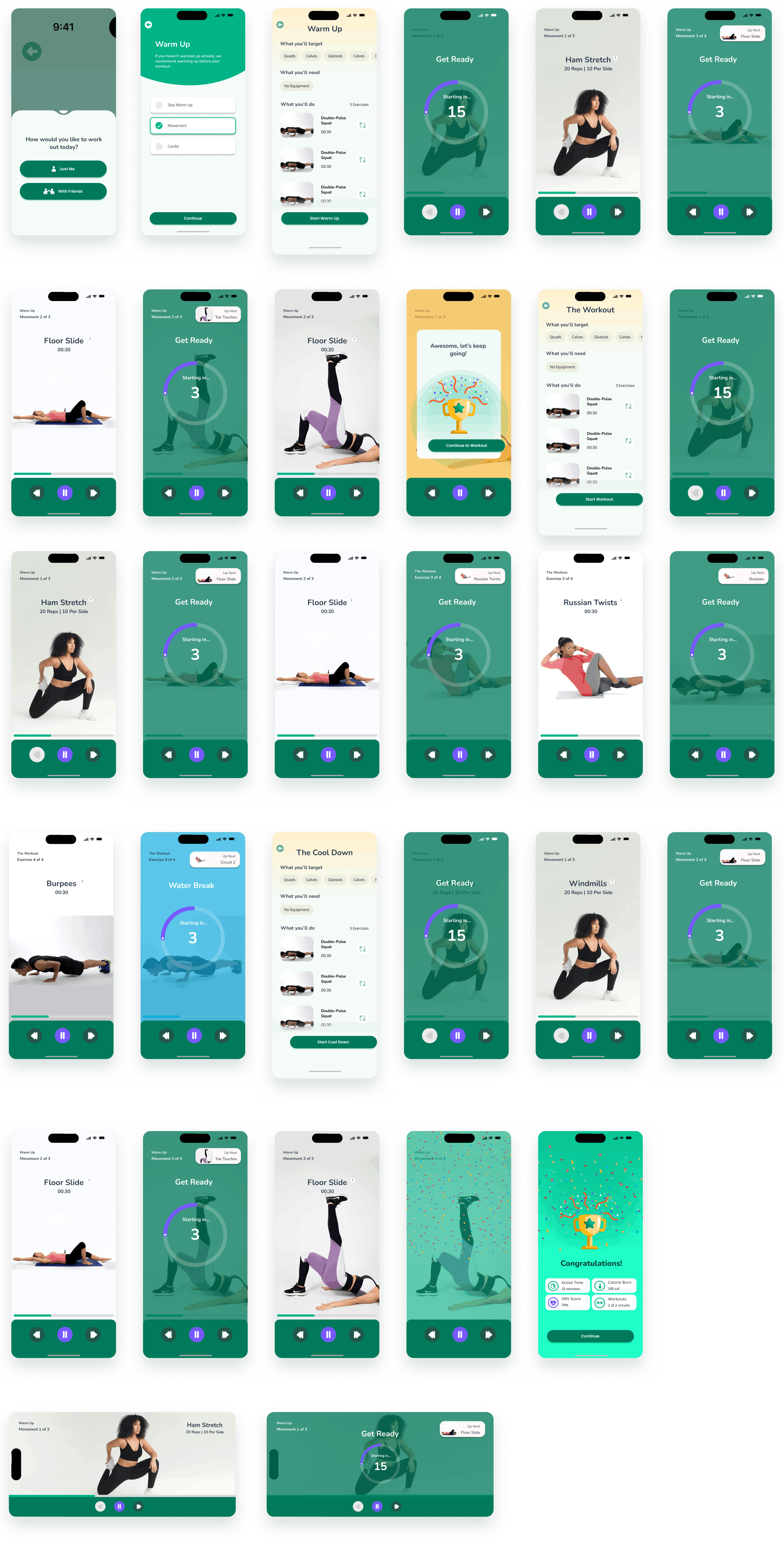
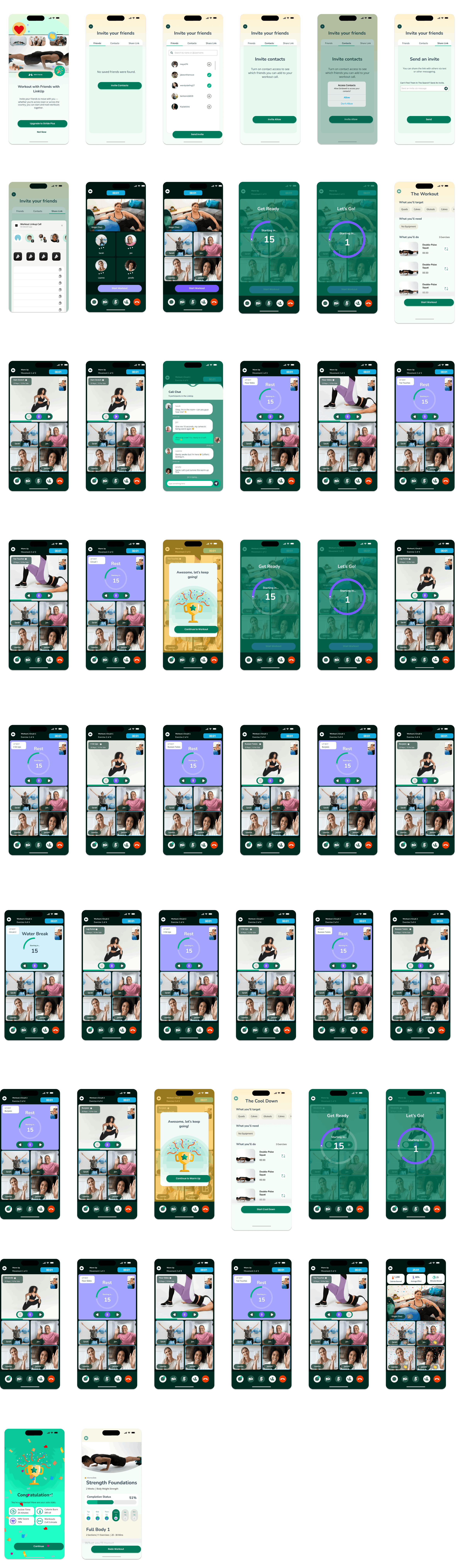
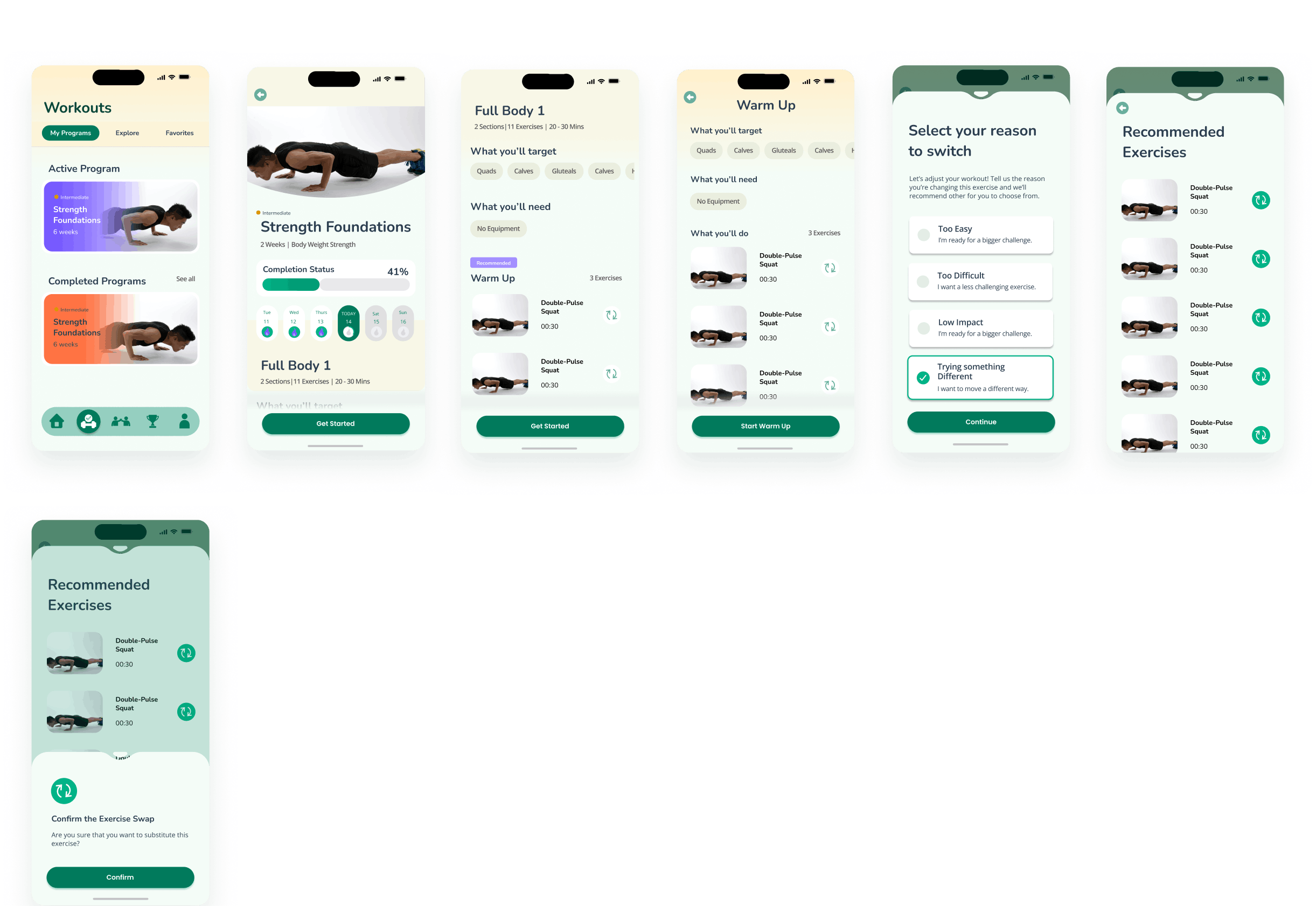
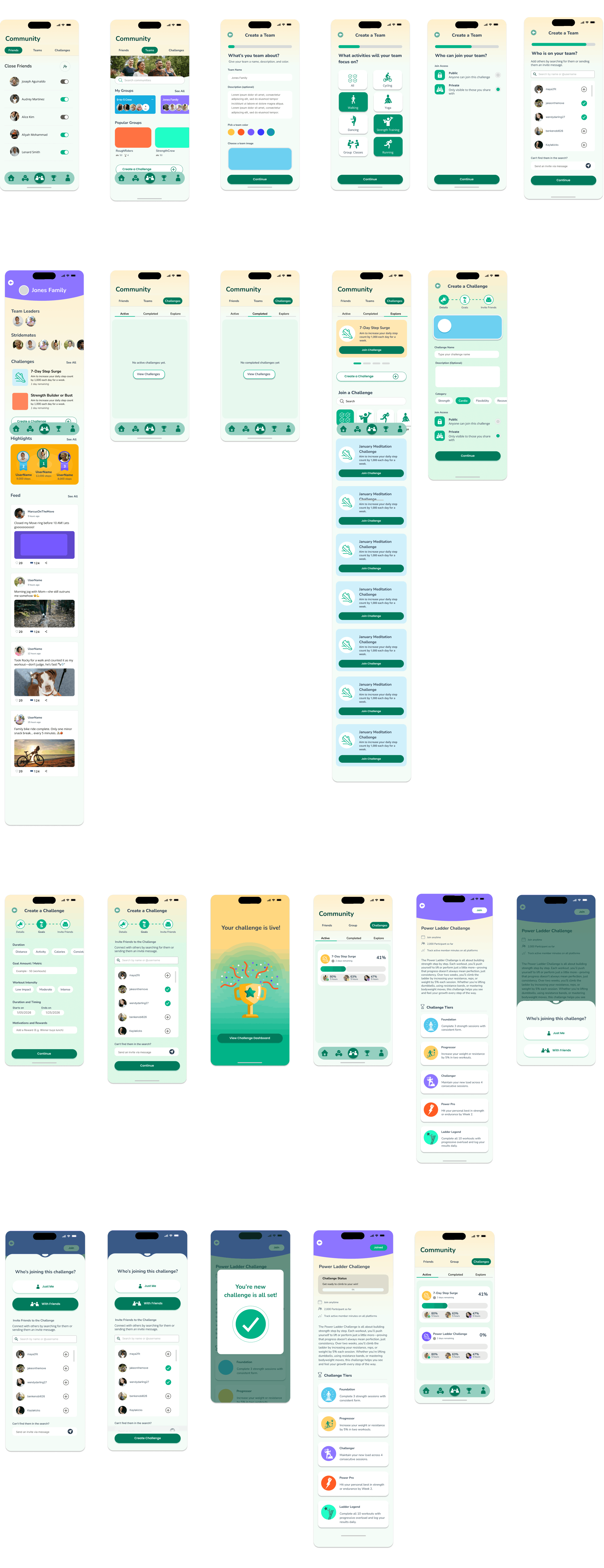
Stridewell is particularly effective at addressing early disengagement caused by guilt, pressure, and isolation—the point where most fitness apps lose users. The design focuses on making re-entry easy after missed days by removing emotional penalties, clarifying social expectations, and acknowledging effort at every level.
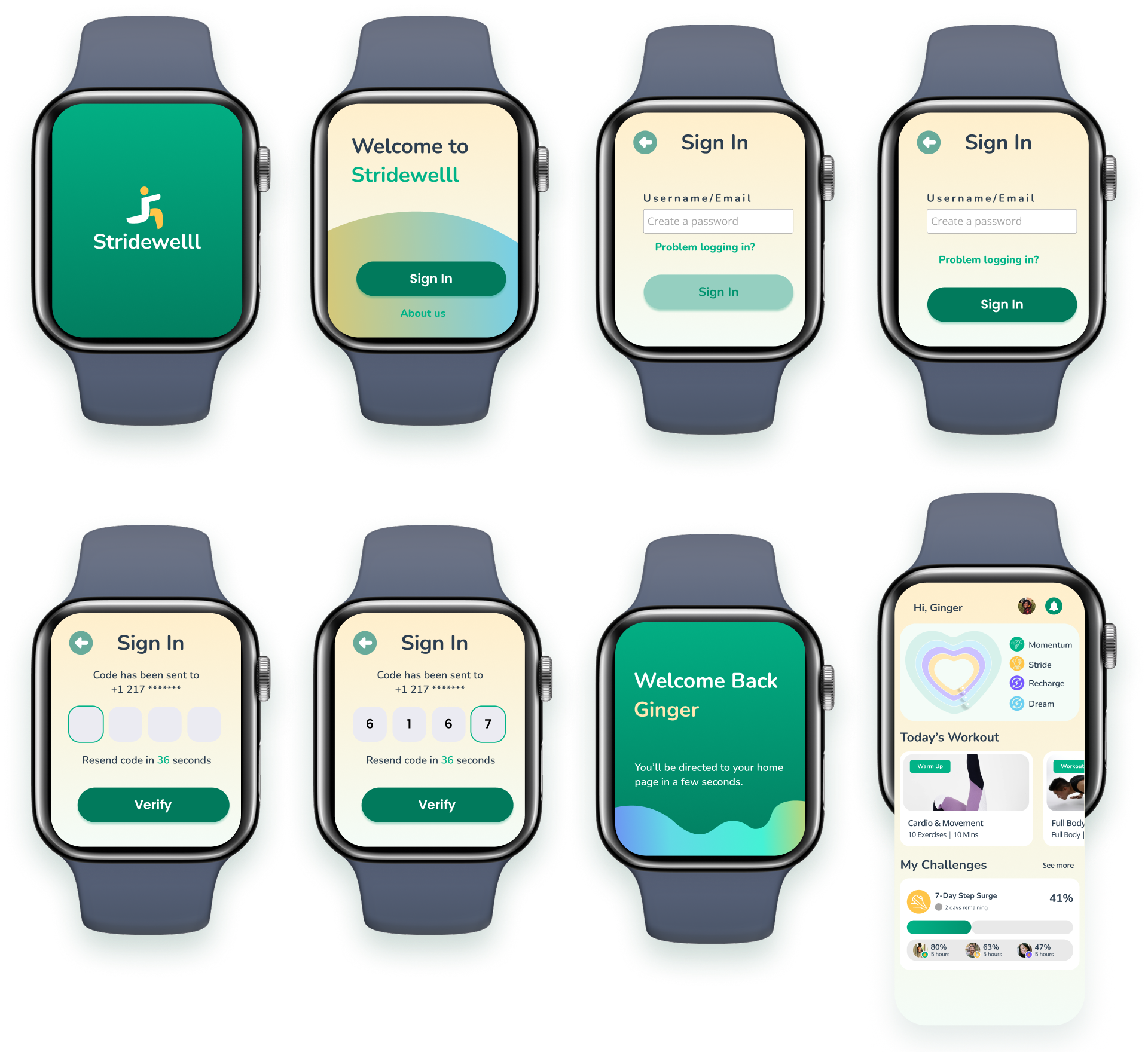
Stridewell supports the original business goal of sustained engagement by focusing on return behavior rather than peak activity. Instead of optimizing for short-term intensity, the design reduces the emotional and cognitive barriers that cause users to disengage after the first few weeks.
This approach is more durable than feature-based engagement tactics such as streaks, leaderboards, or aggressive gamification. Those patterns often create short-term spikes but collapse once users fall behind or feel compared. Stridewell’s design is grounded in human behavior: motivation fluctuates, life intervenes, and systems must adapt. By embedding flexibility, emotional safety, and social support into core flows, engagement is sustained through trust and usability rather than pressure.
User wellbeing is treated as a leading indicator of product success. By reducing guilt, pressure, and isolation, the design increases the likelihood of long-term retention and lifetime value. Stridewell grows by earning repeat use, not forcing it—aligning business health with a healthier, more humane user experience.
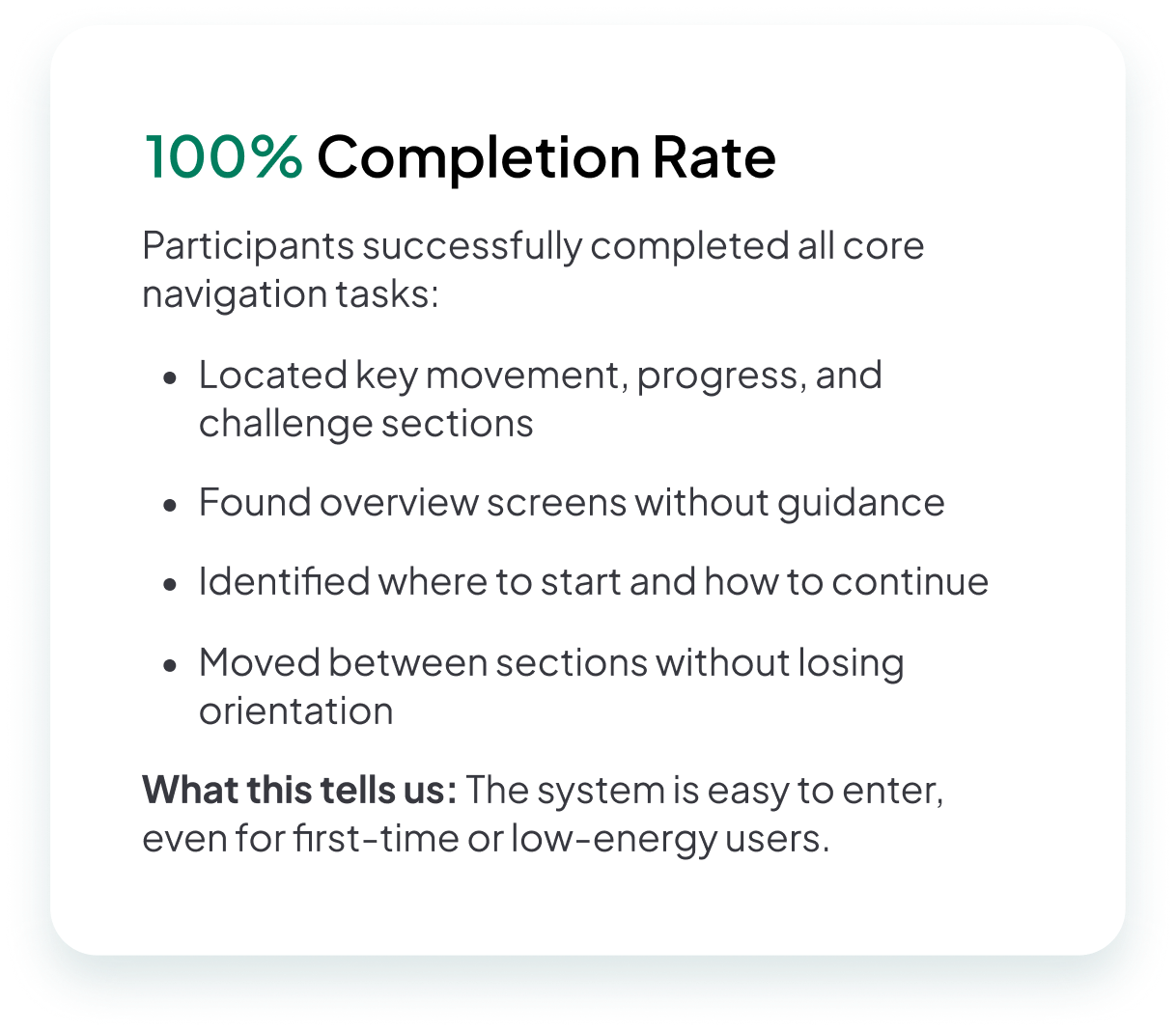
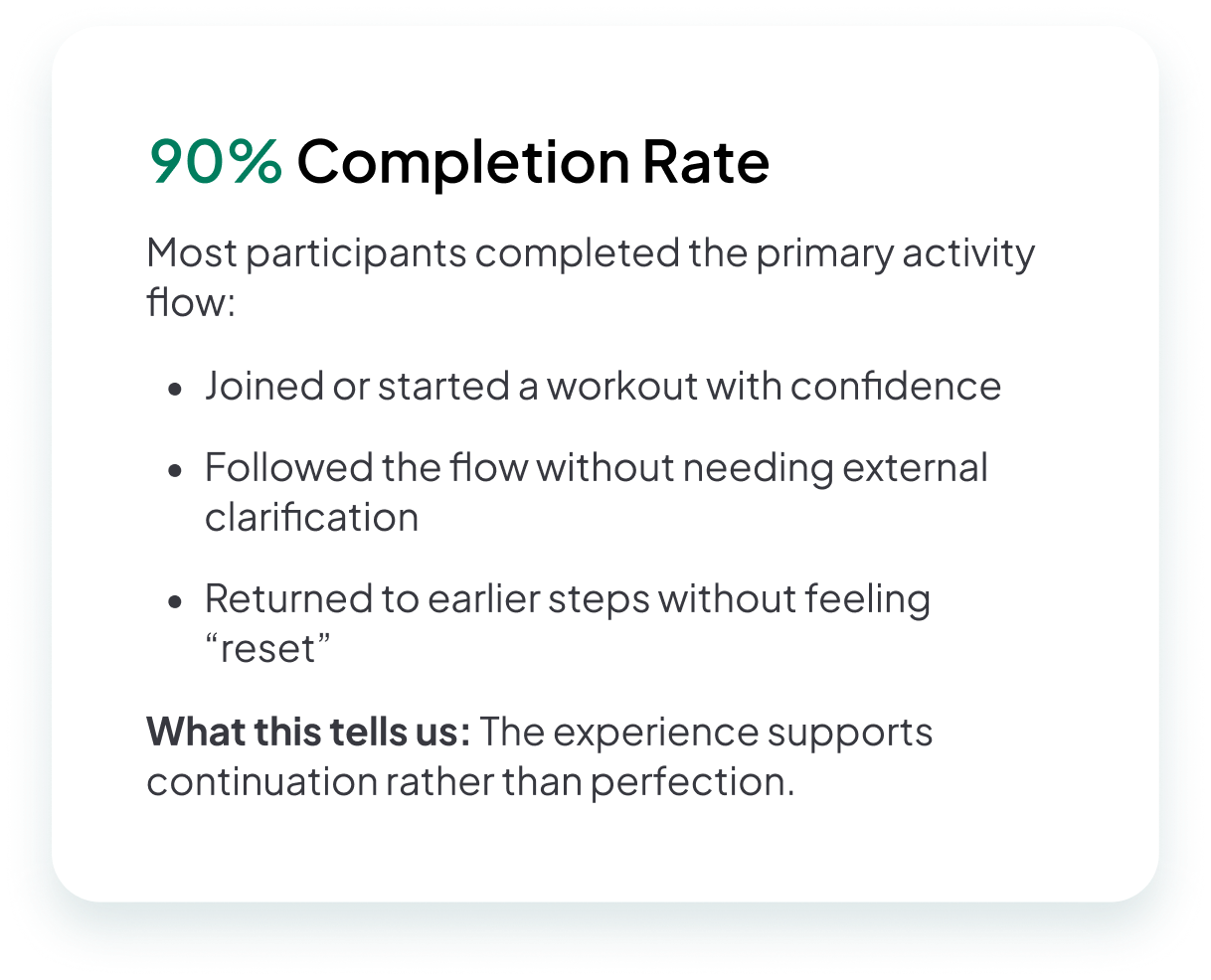
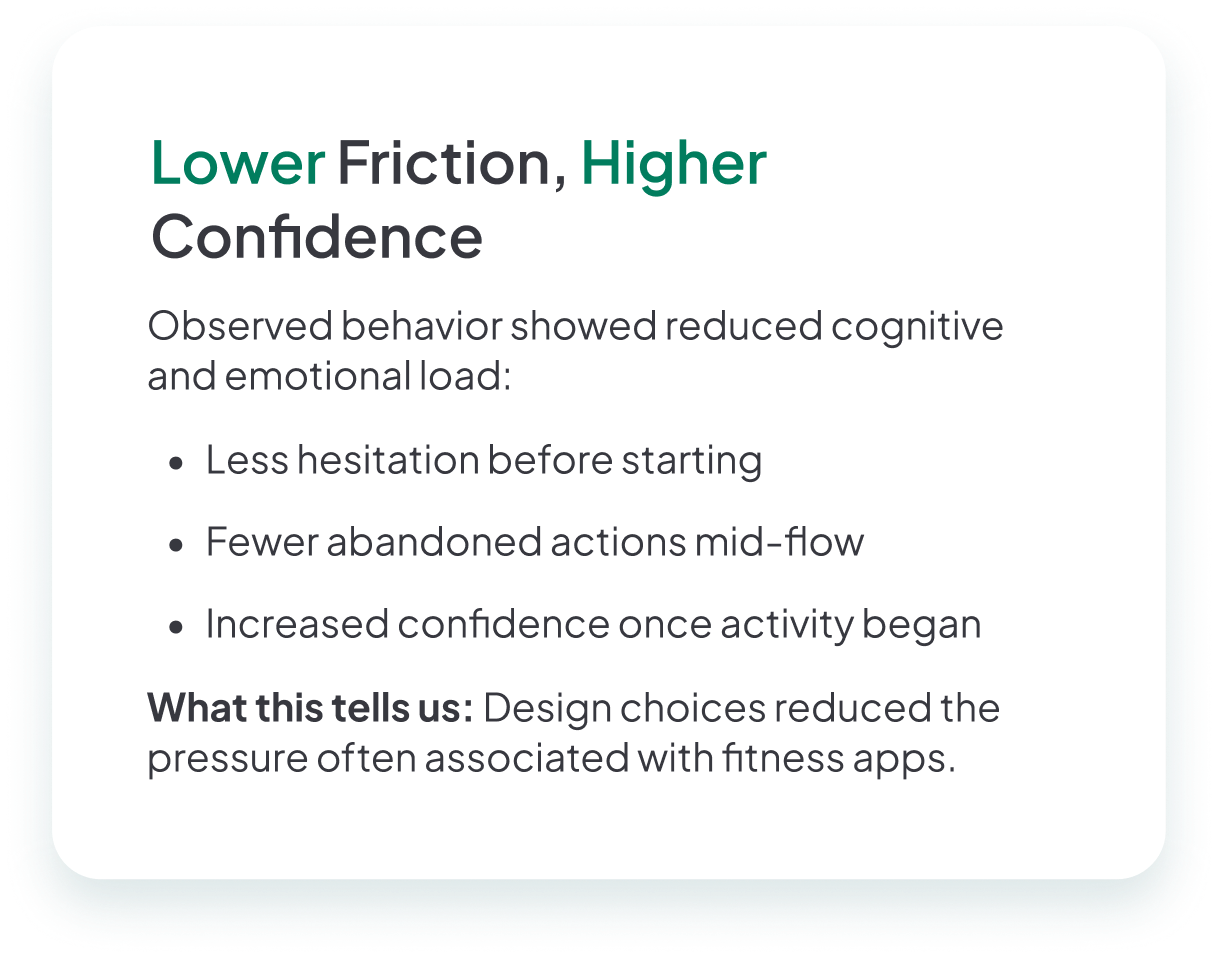
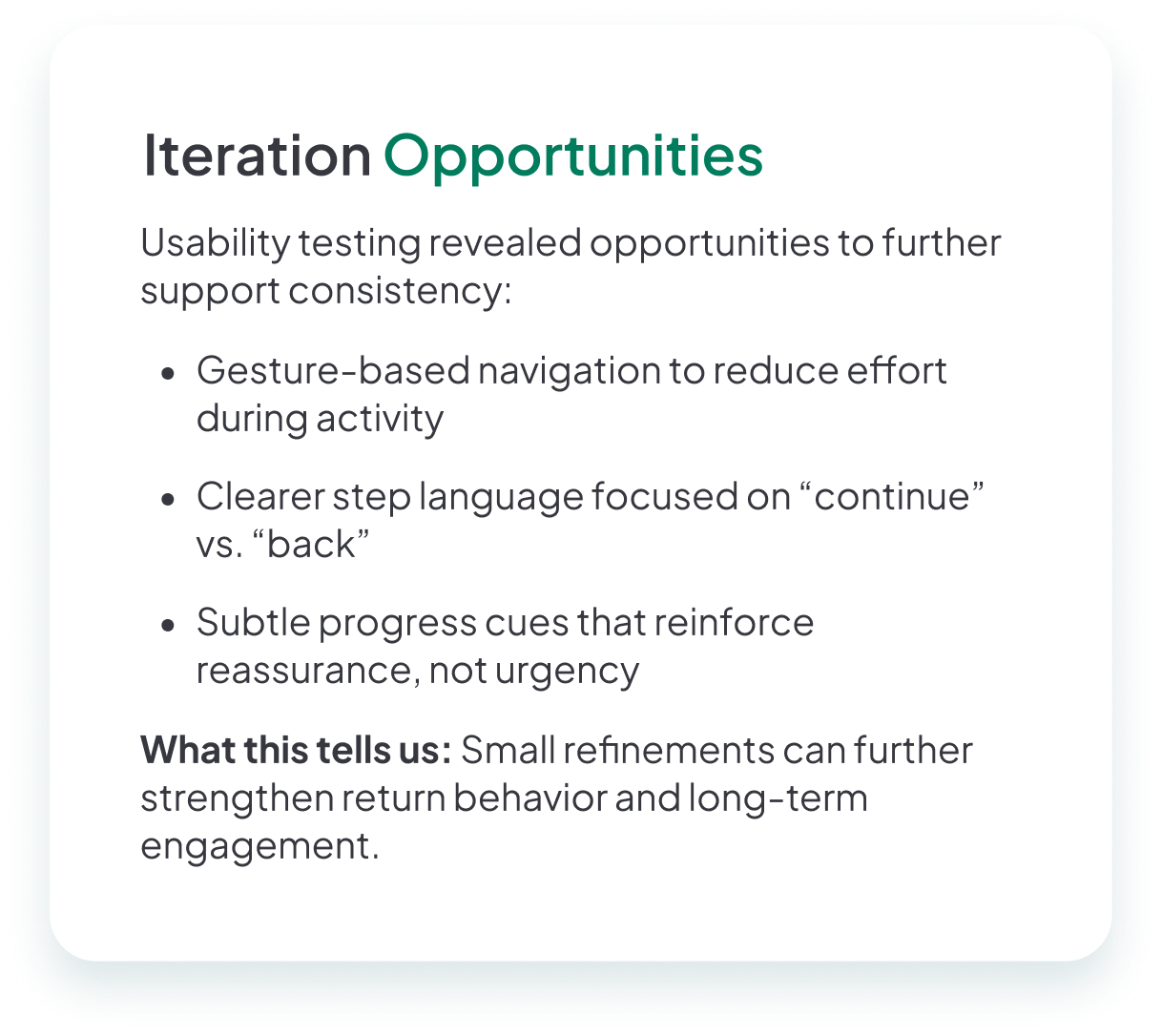
Once live, Stridewell‘s success will be measured through signals of return, recovery, and sustained use rather than raw activity volume. Key metrics would include Day 1, Day 7, and Day 30 retention; frequency of app reopens after inactivity; participation mode usage; completion and partial-completion rates; engagement with contextual messaging; and drop-off points in onboarding and social flows.
In the first 30 days, priority metrics would include Day 7 and Day 30 retention, return-after-miss rates, time to first shared activity, onboarding completion, and repeat participation at any intensity. To evaluate recovery behavior specifically, I would look for users returning after gaps of 2–7 days without abandonment, continued engagement after missed days, and qualitative signals describing the app as “easy to come back to” or “low pressure.”
This project fundamentally reshaped how I think about motivation and behavior change. I learned that motivation is not something designers can reliably create—it’s something we have to design around. Habits break, life intervenes, and motivation fluctuates. The most impactful designs are not the ones that perform best when users feel energized, but the ones that make returning feel possible after disruption.
I also left behind the assumption that disengagement signals a lack of discipline or motivation. Research showed that people often disengage as a rational response to systems that increase guilt, pressure, or ambiguity. When users stop using fitness apps, it’s rarely because they stopped caring—it’s because the experience stopped supporting them.
This project made the emotional impact of common fitness design patterns impossible to ignore. Patterns like streaks, leaderboards, and public comparison may drive short-term activity, but they often shame users once routines break. Emotionally, they turn wellness into a test rather than a support system.
In practice, this meant choosing restraint over persuasion. I intentionally removed streak loss, avoided aggressive reminders, and refused to default users into competitive or public experiences. Instead of relying on urgency or fear of failure, I focused on creating conditions where action felt safe, achievable, and self-directed.
Stridewell reinforced that features don’t drive behavior—systems do. Workouts, challenges, groups, and messaging only work when they reinforce one another within a clear behavioral loop. Designing features in isolation creates fragmentation; designing systems creates momentum.
Thinking in terms of loops, recovery, and return behavior shifted my approach from asking, “How do we get users to do more?” to “How do we help users come back?” Recovery became as important as activation, influencing decisions across onboarding, feedback, social timing, and interaction design.
This project also strengthened my confidence in making principled trade-offs. I’m now more comfortable choosing emotional safety over short-term engagement, clarity over feature density, and flexibility over rigid structure—even when those decisions go against common growth tactics.


Copyright © Torrie Real
